English speaking lesson · Shopping & Money
How to Haggle at a Market in English: Phrases, Dialogues & Speaking Practice
Last updated:
To haggle at a market in English, show interest, ask the price, then make a polite lower offer: "It's beautiful, but a bit over my budget — would you take $25?" The seller will usually make a counteroffer, and you go back and forth until you agree on a price. Below you'll find a full seller–customer dialogue at four levels (A1 to C1), the phrases worth copying, and a free lesson where you practice it with an AI market seller.
The dialogues use American English ($).
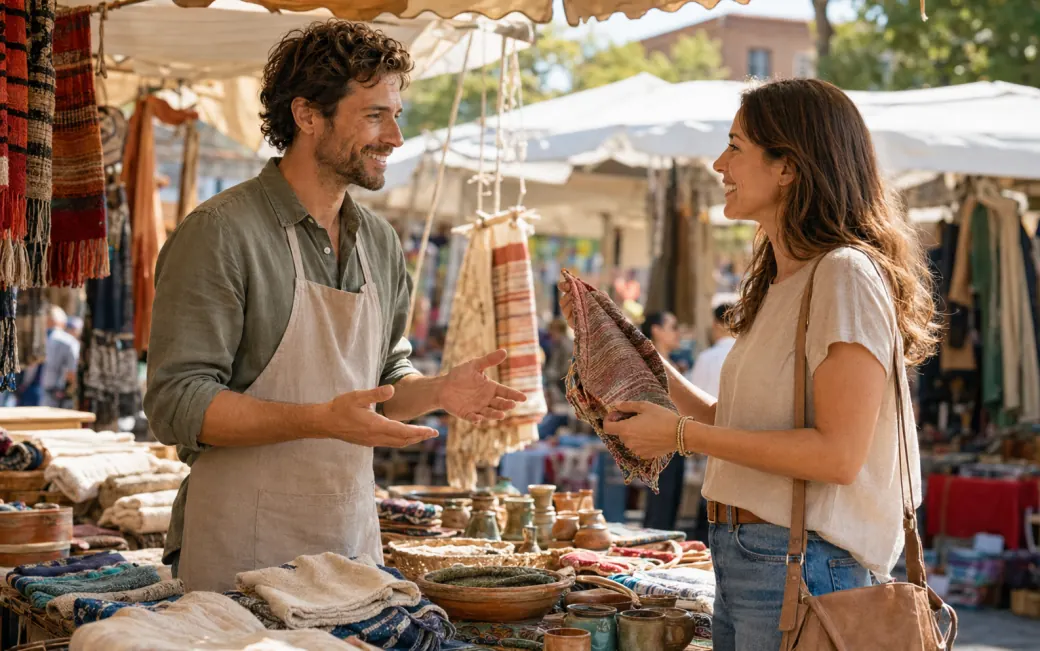
You're at an open-air market where prices are flexible, and something has caught your eye. You practice it as a real conversation with a free AI English tutor, at whichever of the four levels fits you — the room and the steps stay the same, only the words get harder.
An open-air market · you talk to the market seller
Free plan: this lesson is free to play at every level, with 10 messages a day, shared across Free Talk and all lessons, corrections on 3 messages per conversation, and standard support. No card needed. The Learning Plan adds unlimited messages and corrections, and priority support — from $1.99 a month or $14.99 a year up to $9.99 a month or $49.99 a year, depending on your region, with a 7-day money-back guarantee. New subscribers get a 7-day free trial of the Learning Plan.
Bargaining dialogue in English: four levels
The same deal, four ways. Each dialogue follows the lesson's five steps and uses words from that level's word list.
Starter · A1–A2
- Seller:Morning! Have a proper look — best prices on the market. Anything caught your eye?
- You:Hi! I like this bag. It's very nice.
- Seller:Thank you! It's handmade.
- You:How much is it?
- Seller:It's $40.
- You:Hmm, it's expensive. Can I have it cheaper? Thirty dollars?
- Seller:I can do $35.
- You:OK, $35. Deal!
- Seller:Deal! Thank you.
- You:I'll pay cash. Thanks!
Conversational · A2–B1
- Seller:Morning! Have a proper look — best prices on the market. Anything caught your eye?
- You:Morning! These handmade bowls are beautiful. I'm interested in the blue one.
- Seller:Good eye — that one's my favorite.
- You:What are you asking for it?
- Seller:$45.
- You:That's a bit over my budget. Could you give me a discount? I can afford about $30.
- Seller:$30 is too low. How about $40?
- You:Let's meet in the middle — $35?
- Seller:OK, $35. It's a deal.
- You:Great — is cash OK? Thanks so much!
Confident · B1–B2
- Seller:Morning! Have a proper look — best prices on the market. Anything caught your eye?
- You:Morning — the craftsmanship on these leather wallets is impressive. Is it genuine leather?
- Seller:Genuine leather, all made by hand.
- You:How much for the brown one?
- Seller:$60.
- You:That's a little steep for me. Is the price negotiable? I was thinking $40 would be reasonable.
- Seller:I can't go that low, but I could do $50.
- You:What if I bundle it with the keychain — $55 for both?
- Seller:That's fair. $55 for both.
- You:Great, let's settle on $55. I'll pay cash — I appreciate it.
Natural · B2–C1
- Seller:Morning! Have a proper look — best prices on the market. Anything caught your eye?
- You:Morning! That lamp's gorgeous — is it a one-off, or do you have others?
- Seller:It's a one-off. It's from an estate sale — 1960s, Danish.
- You:Love the provenance. What ballpark are we talking?
- Seller:$180.
- You:I don't usually haggle, but would you take $120?
- Seller:Ha — I can't go that low. $160.
- You:Could you budge a little more? $140, and I'll take it off your hands right now.
- Seller:$150 — final offer.
- You:$150 it is. Shake on it? I've got cash.
More shopping lessons: Try Buying a gift, Changing money or Trying clothes on. Related guide: How to stop translating in your head when you speak English.
Useful English phrases for haggling
Copy these and you can bargain politely at almost any market. Each one has a copy button.
Showing interest
This is beautiful — is it handmade?
How much is this?
What's your best price?
Making an offer
Would you take $25?
That's a bit over my budget.
Could you do it for $30?
Meeting in the middle
Let's meet in the middle — $35? — a price halfway between your two offers.
What if I buy two?
That's my final offer.
Closing the deal
OK, it's a deal.
Do you take cash?
Thanks — have a good day!
What the seller might say
Understanding the answers is half the job. These are the ones you'll hear most.
Anything catch your eye?
That's already a good price.
I can do $35, but that's my lowest.
Final offer. — they won't go any lower.
Buy two and I'll give you a discount.
Cash only.
Deal!
What you have to do
Say what you like, ask the price, agree a better one, and buy it. You finish the lesson by getting there in conversation — not by answering questions about it. The tutor never stops to correct you; the feedback appears beside your own messages, and the completion screen collects it all.
How it opens
Morning! Have a proper look — best prices on the market. Anything caught your eye?
Spoken aloud by the tutor playing the market seller.
The 5 steps that finish it
A step clears when you say the thing that clears it. The steps are identical at all four levels — only the example line fades, and at Natural there is none at all.
- 01
Say what you like
Say hello, and say what you're interested in.
“Hello! I like this one — it's very nice.”
- 02
Ask the price
Ask how much it costs.
“How much is it?”
- 03
Ask for a better price
Say it's a bit high, and offer a lower price.
“That's a bit expensive. How about thirty?”
- 04
Agree a price
Check the deal is right, and agree on it.
“Yes, it's a deal!”
- 05
Pay and finish
Say how you'd like to pay, and finish warmly.
“In cash, please. Thanks a lot!”
The words, at all four levels
The same room and the same steps, four vocabularies. These are the words the lesson listens for and scores you on — with what each one means and how it sounds when you are talking to the market seller.
Starter
A1 – A2Simple, everyday words with a full hint on every step.
- nice
- pleasant, good
- “This is very nice.”
- like
- to enjoy or want something
- “I like this one.”
- much
- used to ask the price — 'how much'
- “How much is it?”
- price
- how much something costs
- “What's the price?”
- expensive
- costing a lot
- “That's a bit expensive.”
- cheaper
- costing less
- “Can it be cheaper?”
- thirty
- the number 30
- “How about thirty?”
- deal
- an agreement on a price
- “It's a deal!”
- cash
- paper money and coins
- “In cash, please.”
- thanks
- a short way to say thank you
- “Thanks a lot!”
Conversational
A2 – B1Common words at a natural pace, with hints to lean on.
- handmade
- made by hand, not machine
- “Is this handmade?”
- asking
- the price you want for something
- “What are you asking for it?”
- discount
- a reduction in price
- “Any discount if I take two?”
- afford
- to have enough money for
- “I can afford about thirty.”
- budget
- the amount you can spend
- “My budget's a bit lower.”
- meet
- to agree somewhere in between
- “Could we meet in the middle?”
- middle
- halfway between two amounts
- “Let's meet in the middle.”
- deal
- an agreement on a price
- “That's a deal, thanks!”
- cash
- paper money and coins
- “I've got cash on me.”
- cheers
- informal thanks
- “Cheers for that!”
Confident
B1 – B2Richer, more specific words, with only light hints.
- craftsmanship
- the skill shown in how something is made
- “Lovely craftsmanship on this.”
- genuine
- real, not a copy
- “Is it genuine leather?”
- negotiable
- open to discussion and change
- “Is the price negotiable?”
- reasonable
- fair and not too much
- “That seems reasonable.”
- steep
- higher than expected
- “That's a touch steep.”
- settle
- to agree on a final figure
- “Could we settle at thirty?”
- bundle
- several items bought together
- “Any discount on a bundle?”
- fair
- reasonable to both sides
- “That's a fair price.”
- sorted
- arranged and settled
- “Lovely, that's sorted.”
- appreciate
- to be grateful for
- “I'd appreciate that.”
Natural
B2 – C1Advanced, idiomatic words — no hints at all.
- haggle
- to argue playfully over a price
- “I do enjoy a good haggle.”
- one-off
- unique, only one of its kind
- “Is it a one-off piece?”
- provenance
- where something came from originally
- “What's the provenance?”
- ballpark
- a rough figure
- “What ballpark are we in?”
- budge
- to move from a fixed position
- “Could you budge a little?”
- cheeky
- slightly bold but good-natured
- “A cheeky offer, I know.”
- chancing
- trying your luck
- “I'm chancing my arm here.”
- shake
- to agree by shaking hands
- “Shall we shake on it?”
- obliged
- grateful for a favour
- “Much obliged.”
- sorted
- dealt with and settled
- “Perfect, we're sorted.”
Haggling in English: FAQ
How do you haggle politely in English?
Show interest, ask the price, then offer a little less in a friendly tone: "It's beautiful, but a bit over my budget — would you take $25?" Expect the seller to come back with a counteroffer.
Is haggling normal in the US and the UK?
In most stores, no — prices are fixed. At flea markets, yard sales and some vintage or antique stalls, polite bargaining is common and often expected.
What does "meet in the middle" mean?
It means agreeing on a price halfway between what you offered and what the seller asked. It's a friendly way to finish a negotiation.
What does "final offer" mean?
It means the price won't change again. You can accept it or politely say "No problem — thanks anyway."
What English level do I need to haggle?
A1 is enough. The Starter dialogue above uses only basic words like "how much", "expensive" and "cheaper". Higher levels add more natural phrases — "is the price negotiable?", "could you budge a little?" — but the steps are the same.
How can I practice haggling in English?
Read the dialogue for your level out loud, then practice it in the free lesson with an AI market seller. In the lesson you speak or type your way through all five steps and get corrections beside each message, without being interrupted.
More Shopping & Money lessons
- Trying clothes on
- Buying a gift
- Collecting an order
- Returning an item
- Arranging delivery
- Choosing electronics
- Choosing a phone plan
- Changing money
- Warranty and repair