English speaking lesson · Food & Drink
At the bakery
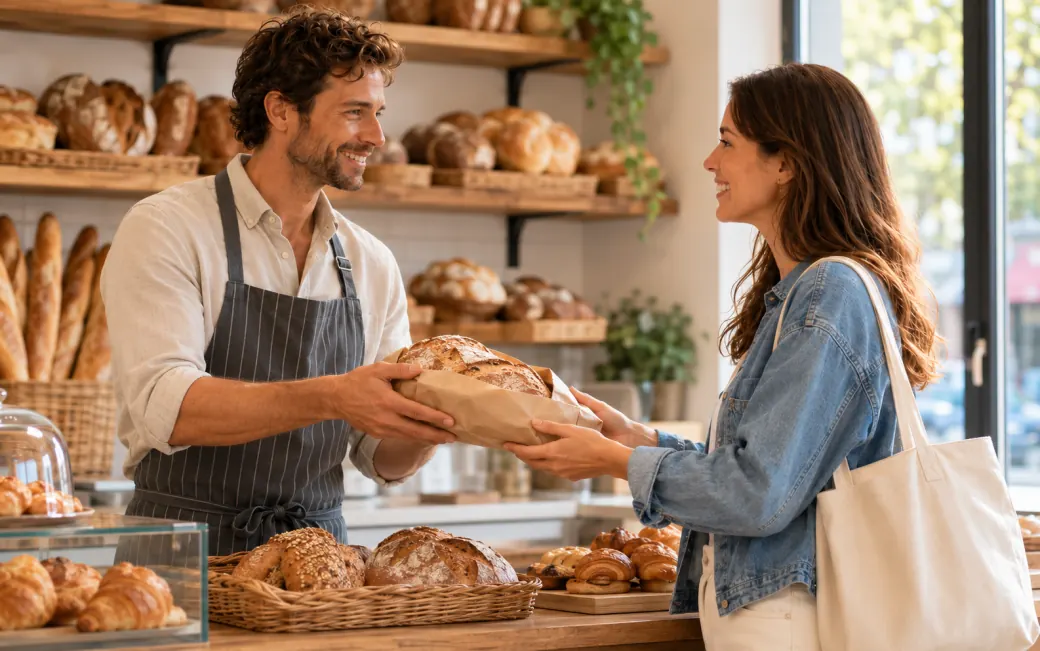
You're at the counter of a small bakery. Everything's fresh out of the oven and the baker is serving. You practice it as a real conversation, at whichever of the four levels fits you — the room and the steps stay the same, only the words get harder.
A small neighbourhood bakery · you talk to the baker
Free plan: this lesson is free to play at every level, with 10 messages a day. No card needed. The Learning Plan makes messages unlimited — $1.99 a month or $14.99 a year, with a 7-day money-back guarantee.
What you have to do
Order some bread, say how much you want, add something sweet, check your order and pay. You finish the lesson by getting there in conversation — not by answering questions about it. The tutor never stops to correct you; the feedback appears beside your own messages, and the completion screen collects it all.
How it opens
Morning! Everything's fresh out this morning — what can I get you?
Spoken aloud by the tutor playing the baker.
The 5 steps that finish it
A step clears when you say the thing that clears it. The steps are identical at all four levels — only the example line fades, and at Natural there is none at all.
- 01
Order some bread
Say hello and order some bread.
“Hi! Some bread, please — a brown loaf.”
- 02
Say how much
Say how many you want, or how you'd like it.
“Two, please.”
- 03
Add something sweet
Ask for something sweet if you'd like — or say no thanks.
“And a cake, please.”
- 04
Check the order
Check your order is right, and ask how much it costs.
“That's everything, thanks. How much is it?”
- 05
Pay and finish
Say how you'd like to pay, and finish politely.
“By card, please!”
The words, at all four levels
The same room and the same steps, four vocabularies. These are the words the lesson listens for and scores you on — with what each one means and how it sounds when you are talking to the baker.
Starter
A1 – A2Simple, everyday words with a full hint on every step.
- bread
- a basic baked food made from flour
- “Some bread, please.”
- loaf
- one whole piece of bread
- “One loaf, please.”
- brown
- the darker kind of bread
- “A brown loaf, please.”
- fresh
- made recently, not old
- “Is it fresh today?”
- two
- the number 2
- “Two, please.”
- cake
- a sweet baked snack
- “And a cake, please.”
- sweet
- tasting of sugar
- “Something sweet, please.”
- much
- used to ask the price — 'how much'
- “How much is it?”
- please
- a polite word when you ask
- “One loaf, please.”
- card
- a bank card you pay with
- “By card, please.”
Conversational
A2 – B1Common words at a natural pace, with hints to lean on.
- sourdough
- a slightly sour bread made with a starter
- “A sourdough loaf, please.”
- wholemeal
- bread made with the whole grain
- “Is the wholemeal fresh?”
- sliced
- cut into pieces
- “Could I have it sliced?”
- baked
- cooked in an oven
- “When was it baked?”
- couple
- two, or a few
- “Just a couple, please.”
- pastry
- a sweet baked snack like a croissant
- “Could I add a pastry?”
- everything
- all of it — 'is that everything?'
- “That's everything, thanks.”
- total
- the full amount to pay
- “What's the total?”
- cheers
- informal thanks
- “Cheers for that!”
- contactless
- tapping a card to pay without a PIN
- “Contactless, please.”
Confident
B1 – B2Richer, more specific words, with only light hints.
- rye
- a dense, dark grain used in bread
- “Do you have a rye loaf?”
- crusty
- with a firm, crisp outside
- “Something crusty, ideally.”
- batch
- one set of things baked together
- “Is this the morning batch?”
- seeded
- topped or mixed with seeds
- “The seeded one, please.”
- halve
- to cut into two equal parts
- “Could you halve it for me?”
- danish
- a light, flaky sweet pastry
- “And a danish, please.”
- tempting
- something you'd really like to have
- “Those look tempting.”
- altogether
- in total — 'how much altogether'
- “How much altogether?”
- receipt
- the printed proof of payment
- “Could I get the receipt?”
- card
- a bank card you pay with
- “Card's fine, thanks.”
Natural
B2 – C1Advanced, idiomatic words — no hints at all.
- artisan
- made carefully by hand in small amounts
- “Is this the artisan range?”
- crumb
- the soft inside texture of bread
- “Lovely open crumb on that.”
- proved
- left to rise before baking
- “How long is it proved for?”
- wholegrain
- containing the entire grain
- “The wholegrain one, please.”
- indulge
- to allow yourself a small treat
- “Go on then, I'll indulge.”
- moreish
- so tasty you want more
- “These look dangerously moreish.”
- damage
- the cost — 'what's the damage?' (informal)
- “What's the damage?”
- tap
- to pay by touching your card
- “I'll just tap.”
- cheers
- informal thanks
- “Cheers, much appreciated.”
- sorted
- dealt with and settled
- “Great, we're sorted.”
More Food & Drink lessons
- Coffee shop order
- Food market stall
- Booking a table
- Order at a restaurant
- Dietary requirements
- Splitting the bill
- At the bar
- Ordering a takeaway
- Room service