English speaking lesson · Food & Drink
Food market stall
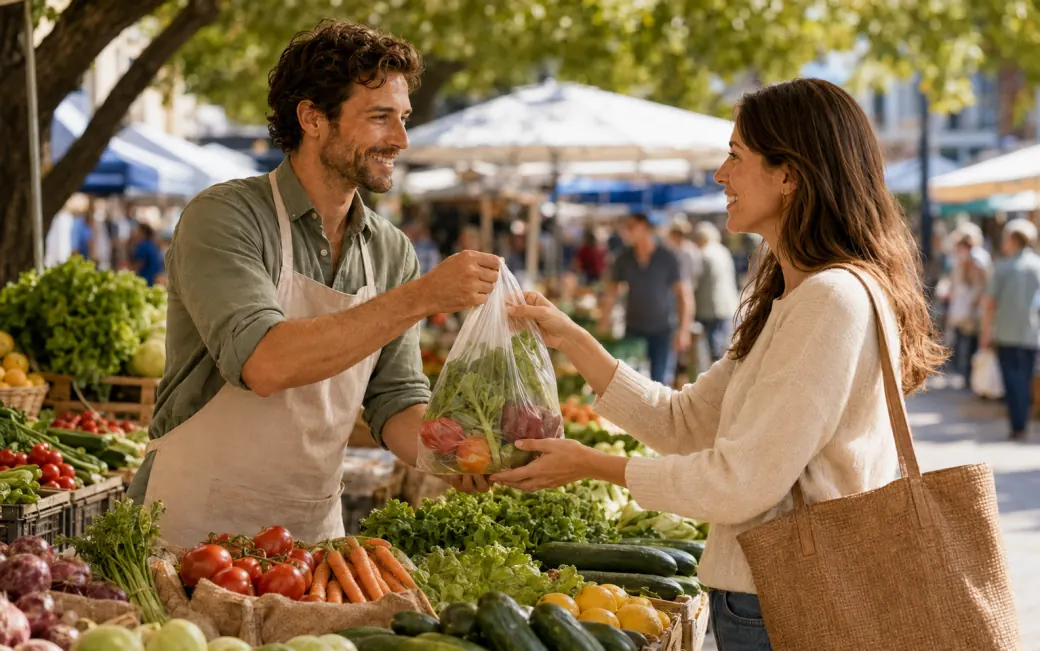
You're at a busy food market. A stallholder is standing behind a table of fresh produce. You practice it as a real conversation, at whichever of the four levels fits you — the room and the steps stay the same, only the words get harder.
A busy outdoor food market · you talk to the stallholder
Free plan: this lesson is free to play at every level, with 10 messages a day. No card needed. The Learning Plan makes messages unlimited — $1.99 a month or $14.99 a year, with a 7-day money-back guarantee.
What you have to do
Say what you're after, choose between two kinds, say how much you want, check the order and pay. You finish the lesson by getting there in conversation — not by answering questions about it. The tutor never stops to correct you; the feedback appears beside your own messages, and the completion screen collects it all.
How it opens
Morning! Have a look, everything came in fresh this morning — what are you after?
Spoken aloud by the tutor playing the stallholder.
The 5 steps that finish it
A step clears when you say the thing that clears it. The steps are identical at all four levels — only the example line fades, and at Natural there is none at all.
- 01
Say what you want
Say hello, and say what you're looking for.
“Hello! Some apples, please.”
- 02
Choose between two
Say which kind you'd prefer, or ask which is better.
“The red ones, please. Are they fresh?”
- 03
Say how much
Say how much or how many you'd like.
“One kilo, please.”
- 04
Check the order
Check the order is right, and ask how much it costs.
“Yes, that's everything. How much is it?”
- 05
Pay and finish
Say how you'd like to pay, and finish politely.
“In cash, please. Thanks!”
The words, at all four levels
The same room and the same steps, four vocabularies. These are the words the lesson listens for and scores you on — with what each one means and how it sounds when you are talking to the stallholder.
Starter
A1 – A2Simple, everyday words with a full hint on every step.
- apples
- a common round fruit
- “Some apples, please.”
- fruit
- sweet food that grows on plants
- “I'd like some fruit.”
- red
- the colour of a tomato
- “The red ones, please.”
- green
- the colour of grass
- “The green ones, please.”
- fresh
- picked recently, not old
- “Are they fresh?”
- kilo
- a unit of weight (1000 grams)
- “One kilo, please.”
- bag
- a thing you carry shopping in
- “Could I have a bag?”
- much
- used to ask the price — 'how much'
- “How much is it?”
- please
- a polite word when you ask
- “A kilo, please.”
- cash
- paper money and coins
- “In cash, please.”
Conversational
A2 – B1Common words at a natural pace, with hints to lean on.
- tomatoes
- a soft red fruit used in cooking
- “Some tomatoes, please.”
- ripe
- ready to eat
- “Are these ripe yet?”
- seasonal
- grown at this time of year
- “What's seasonal right now?”
- sweeter
- more sweet than the other
- “Which is sweeter?”
- handful
- a small amount you can hold
- “Just a handful, please.”
- grams
- a small unit of weight
- “Five hundred grams, please.”
- everything
- all of it — 'is that everything?'
- “That's everything, thanks.”
- total
- the full amount to pay
- “What's the total?”
- cheers
- informal thanks
- “Cheers for that!”
- contactless
- tapping a card to pay without a PIN
- “Contactless, please.”
Confident
B1 – B2Richer, more specific words, with only light hints.
- produce
- fruit and vegetables sold in a shop
- “Lovely produce today.”
- variety
- a particular kind of a plant or fruit
- “Which variety is that?”
- locally
- from somewhere nearby
- “Is it grown locally?”
- punnet
- a small basket fruit is sold in
- “A punnet, please.”
- loose
- sold singly, not in a pack
- “Are they sold loose?”
- flavour
- how something tastes
- “Which has more flavour?”
- altogether
- in total — 'how much altogether'
- “How much altogether?”
- receipt
- the printed proof of payment
- “Could I get a receipt?”
- grab
- to get something quickly (informal)
- “I'll grab a punnet.”
- appreciate
- to be grateful for
- “I'd appreciate that.”
Natural
B2 – C1Advanced, idiomatic words — no hints at all.
- heirloom
- an older, traditional variety of a plant
- “Are these heirloom?”
- peak
- at its very best
- “They're at their peak right now.”
- seasonal
- grown at this time of year
- “What's properly seasonal?”
- pick
- the best of what's available
- “What's the pick of the day?”
- smattering
- a small scattered amount
- “Just a smattering, thanks.”
- pop
- to put quickly (informal) — 'pop it in'
- “Pop a few in for me.”
- damage
- the cost — 'what's the damage?' (informal)
- “What's the damage?”
- tap
- to pay by touching your card
- “I'll just tap.”
- cheers
- informal thanks
- “Cheers, appreciated.”
- sorted
- dealt with and settled
- “Lovely, we're sorted.”
More Food & Drink lessons
- Coffee shop order
- At the bakery
- Booking a table
- Order at a restaurant
- Dietary requirements
- Splitting the bill
- At the bar
- Ordering a takeaway
- Room service