English speaking lesson · Food & Drink
How to Order Coffee in English: Phrases, Dialogues & Speaking Practice
Last updated:
To order coffee in English, say the size, then the drink, then any extras: "Could I get a medium latte with oat milk, please?" The barista will usually ask if you want anything else, whether it's for here or to go, and how you'd like to pay. Below you'll find a full barista–customer dialogue at four levels (A1 to C1), the phrases worth copying, and a free lesson where you practice it with an AI barista.
The dialogues use American English ($, "to go"). British differences are covered in the FAQ.
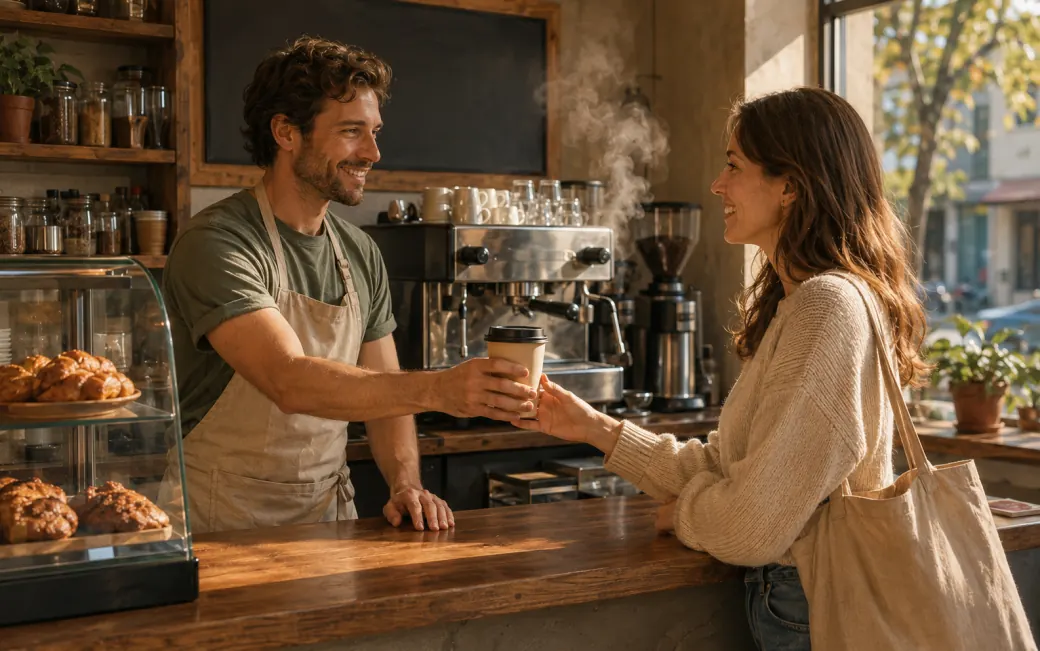
You're at a neighborhood café counter. A friendly barista is taking your order. You practice it as a real conversation with a free AI English tutor, at whichever of the four levels fits you — the room and the steps stay the same, only the words get harder.
A busy neighborhood café · you talk to the barista
Free plan: this lesson is free to play at every level, with 10 messages a day, shared across Free Talk and all lessons, corrections on 3 messages per conversation, and standard support. No card needed. The Learning Plan adds unlimited messages and corrections, and priority support — from $1.99 a month or $14.99 a year up to $9.99 a month or $49.99 a year, depending on your region, with a 7-day money-back guarantee. New subscribers get a 7-day free trial of the Learning Plan.
Coffee shop dialogue in English: four levels
The same visit, four ways. Each dialogue follows the lesson's five steps and uses words from that level's word list.
Starter · A1–A2
- Barista:Morning! Welcome in. What can I get for you today?
- You:Hi! Can I have a hot coffee, please?
- Barista:Sure. What size — small, medium or large?
- You:Small, please.
- Barista:Milk and sugar?
- You:With milk, please. No sugar.
- Barista:OK. Anything to eat?
- You:Yes. Can I get a slice of chocolate cake, please?
- Barista:Of course. Is that everything?
- You:Yes, that's everything, thanks. How much is it?
- Barista:That's $7.50. Card or cash?
- You:Card, please.
- Barista:There you go. Enjoy!
- You:Thank you. Bye!
Conversational · A2–B1
- Barista:Morning! Welcome in. What can I get for you today?
- You:Morning! Could I get a latte, please?
- Barista:Sure. Regular or large?
- You:Is regular the same as medium?
- Barista:Yes, regular is our medium.
- You:A regular, then. Could I have it with oat milk?
- Barista:Of course. Anything to eat with that?
- You:Maybe. Which pastry would you recommend?
- Barista:The almond croissant — it's our bestseller.
- You:Perfect, I'll have one.
- Barista:So that's a regular oat latte and an almond croissant. Is that everything?
- You:Yes, that's everything. What's the total?
- Barista:$8.25, please.
- You:Can I pay contactless?
- Barista:Sure — just tap your card here.
- You:Thanks so much!
Confident · B1–B2
- Barista:Morning! Welcome in. What can I get for you today?
- You:Morning — I'll have a decaf macchiato, please.
- Barista:Sure. It normally comes with whole milk — is that OK?
- You:Could I swap that for oat?
- Barista:Of course. Oat milk is 75 cents extra.
- You:That's fine. And could I get an extra shot? It's been a long week.
- Barista:An extra decaf shot — no problem. For here or to go?
- You:To go, please. I'll grab a croissant too, if you have any left.
- Barista:Last one — lucky you! Anything else?
- You:No, that's it. How much is that altogether?
- Barista:That comes to $9.40.
- You:Card's fine. Could I get the receipt, please? I need it for expenses.
- Barista:Here you go. Your drink will be ready at the end of the counter.
- You:Great, thanks.
Natural · B2–C1
- Barista:Morning! Welcome in. What can I get for you today?
- You:Morning! I'd normally get my usual flat white, but I'm in the mood for something different — I'll try a cortado.
- Barista:Good choice. Any syrup with that?
- You:I'll skip the syrup, thanks. Could I tweak it a little, though — with an extra shot?
- Barista:Strong start to the day! Anything from the case? The cinnamon rolls just came out of the oven.
- You:Oh, those look tempting. Why not — I'll indulge.
- Barista:Good call. For here?
- You:For here, please. OK, what's the damage?
- Barista:$8.60, please.
- You:I'll just tap.
- Barista:Perfect. Anything else I can get you?
- You:Nope, I'm all set, thanks. Have a good one!
Ordering food next? Try Order at a restaurant, At the bakery or Ordering a takeaway.
Useful English phrases for ordering coffee
Copy these and you can handle almost any café. Each one has a copy button.
Ordering
Can I get a flat white, please? — the most common way to order, in the US and the UK.
Could I have a small cappuccino, please? — slightly more formal, always polite.
I'll have a latte, please. — natural once you've decided.
What would you recommend? — when you don't know the menu.
What sizes do you have?
Making it your way
Could I have that with oat milk?
No sugar, thanks.
Could I get an extra shot?
Can I swap the milk for soy?
Could I have it iced, please?
For here or to go
For here, please. / To go, please. — American English.
To have here, please. / To take away, please. — British English.
Finishing and paying
That's everything, thanks.
How much is that? / What's the total?
Can I pay by card? / Can I pay contactless?
Could I get a receipt, please?
When something goes wrong
Sorry, could you say that again?
Actually, could I change my order?
What the barista might say
Understanding the questions is half the job. These are the ones you'll hear most.
What can I get for you? / What'll it be? — they're ready for your order.
What size would you like?
For here or to go? (US) / Eat in or take away? (UK)
Any milk? / Whole, skim or oat? — UK: whole, skimmed or oat?
Anything else? / Is that everything?
Can I get a name for the order? — common at US chains; they'll call it when your drink is ready.
Card or cash?
Would you like a receipt?
What you have to do
Order a drink, add a snack, check your order, and pay. You finish the lesson by getting there in conversation — not by answering questions about it. The tutor never stops to correct you; the feedback appears beside your own messages, and the completion screen collects it all.
How it opens
Morning! Welcome in. What can I get for you today?
Spoken aloud by the tutor playing the barista.
The 5 steps that finish it
A step clears when you say the thing that clears it. The steps are identical at all four levels — only the example line fades, and at Natural there is none at all.
- 01
Order a drink
Say hi and order one drink.
“Hi! Can I get a hot coffee, please?”
- 02
Say how you like it
Say what size you want, and how you like it.
“A small, please — with milk, no sugar.”
- 03
Add a snack
Ask for a snack if you'd like one — or say no thanks.
“Can I get a cake too, please?”
- 04
Check the order
Check your order is right, and ask how much it costs.
“That's everything, thanks. How much is it?”
- 05
Pay and finish
Say how you'd like to pay, and finish politely.
“By card, please!”
The words, at all four levels
The same room and the same steps, four vocabularies. These are the words the lesson listens for and scores you on — with what each one means and how it sounds when you are talking to the barista.
Starter
A1 – A2Simple, everyday words with a full hint on every step.
- coffee
- a hot drink made from roasted beans
- “Can I have a coffee, please?”
- hot
- having a high temperature
- “A hot coffee, please.”
- please
- a polite word when you ask for something
- “A coffee, please.”
- small
- not big — the little size
- “A small, please.”
- milk
- the white liquid you add to coffee
- “With milk, please.”
- sugar
- sweet white grains you add to drinks
- “No sugar, thanks.”
- cake
- a sweet baked snack
- “Can I get a cake too?”
- much
- used to ask the price — 'how much'
- “How much is it?”
- thanks
- a short way to say thank you
- “That's everything, thanks.”
- card
- a bank card you pay with
- “By card, please.”
Conversational
A2 – B1Common words at a natural pace, with hints to lean on.
- latte
- a coffee with lots of steamed milk
- “I'll have a latte, please.”
- regular
- the normal or standard size
- “A regular, please.”
- recommend
- to suggest something good
- “What would you recommend?”
- oat
- a plant milk made from oats
- “With oat milk, please.”
- medium
- the middle size
- “A medium, please.”
- pastry
- a sweet baked snack like a croissant
- “Could I add a pastry?”
- everything
- all of it — 'is that everything?'
- “That's everything, thanks.”
- total
- the full amount to pay
- “What's the total?”
- cheers
- informal thanks
- “Cheers for that!”
- contactless
- tapping a card to pay without a PIN
- “Contactless, please.”
Confident
B1 – B2Richer, more specific words, with only light hints.
- macchiato
- a shot of espresso with a dash of milk
- “I'll have a macchiato, please.”
- usual
- the thing you always order
- “I'll have my usual.”
- decaf
- coffee with the caffeine removed
- “Make it a decaf, please.”
- extra
- an added amount of something
- “Can I get an extra shot?”
- swap
- to exchange one thing for another
- “Could I swap the milk for oat?”
- croissant
- a flaky buttery pastry
- “And a croissant, please.”
- grab
- to get something quickly (informal)
- “I'll grab a croissant too.”
- altogether
- in total — 'how much altogether'
- “How much altogether?”
- receipt
- the printed proof of payment
- “Could I get the receipt?”
- card
- a bank card you pay with
- “Card's fine, thanks.”
Natural
B2 – C1Advanced, idiomatic words — no hints at all.
- usual
- the thing you always order
- “My usual, cheers.”
- tweak
- to change something a little
- “Let me tweak it a bit.”
- cortado
- espresso cut with a little warm milk
- “I'll go for a cortado.”
- shot
- a single measure of espresso
- “With an extra shot.”
- skip
- to leave something out
- “I'll skip the sugar.”
- tempting
- something you'd really like to have
- “Those look tempting.”
- indulge
- to allow yourself a small treat
- “Go on then, I'll indulge.”
- damage
- the cost — 'what's the damage?' (informal)
- “What's the damage?”
- tap
- to pay by touching your card
- “I'll just tap.”
- sorted
- dealt with and settled
- “Great, we're sorted.”
Ordering coffee in English: FAQ
How do you order coffee politely in English?
Say the size, the drink and any extras, and add "please": "Could I get a medium latte with oat milk, please?" "Can I get…" and "Could I have…" are both polite. Avoid "I want a coffee" — it isn't wrong, but it can sound abrupt.
Is "Can I get a coffee?" rude?
No. "Can I get…?" is the standard way to order in cafés in both the US and the UK. Some people find "Could I have…?" a little more polite, so use that if you're unsure, but nobody behind the counter will think "Can I get" is rude.
What's the difference between "for here" and "to go"?
"For here" means you'll stay and drink it in the café; "to go" means you'll take it with you. That's how Americans say it. In the UK you'll more often hear "eat in or take away?" or "to have here or to take away?". Answer with the same words the barista used.
How do you ask for the check politely?
In most coffee shops you pay at the counter when you order, so just ask "How much is that?". If you're served at a table, catch the server's eye and say "Could we get the check, please?" In the UK, people say "Could we have the bill, please?"
Do you tip in coffee shops?
In the US, card readers often suggest a tip at the counter; it's appreciated but optional. At table service, 15–20% is standard. In the UK, tipping at the counter isn't expected, and at table service 10–12.5% is common if service isn't already included.
What English level do I need to order coffee?
A1 is enough. The Starter dialogue above uses only basic words like "small", "milk" and "how much". Higher levels add more natural phrases — "swap that for oat", "what's the damage?" — but the steps are the same.
How can I practice ordering coffee in English?
Read the dialogue for your level out loud, then practice it in the free lesson with an AI barista. In the lesson you speak or type your way through all five steps and get corrections beside each message, without being interrupted.
More Food & Drink lessons
- At the bakery
- Food market stall
- Booking a table
- Order at a restaurant
- Dietary requirements
- Splitting the bill
- At the bar
- Ordering a takeaway
- Room service