English speaking lesson · Home & Living
How to Call a Plumber in English: Phrases, Dialogues & Speaking Practice
Last updated:
To call a plumber in English, describe the problem, give your address, and ask about timing and cost: "Hi, my kitchen sink is leaking under the cabinet. Could someone come today?" The plumber will usually ask a few questions, offer a time, and explain the price. Below you'll find a full phone dialogue at four levels (A1 to C1), the phrases worth copying, and a free lesson where you practice it with an AI plumber.
The dialogues use American English ($). British differences are covered in the FAQ.
There's a leak under your kitchen sink, and you're calling a local plumber. You practice it as a real conversation with a free AI English tutor, at whichever of the four levels fits you — the room and the steps stay the same, only the words get harder.
A call to a local plumber · you talk to the plumber
Free plan: this lesson is free to play at every level, with 10 messages a day, shared across Free Talk and all lessons, corrections on 3 messages per conversation, and standard support. No card needed. The Learning Plan adds unlimited messages and corrections, and priority support — $9.99 a month or $49.99 a year, with a 7-day money-back guarantee. Prices vary by region.
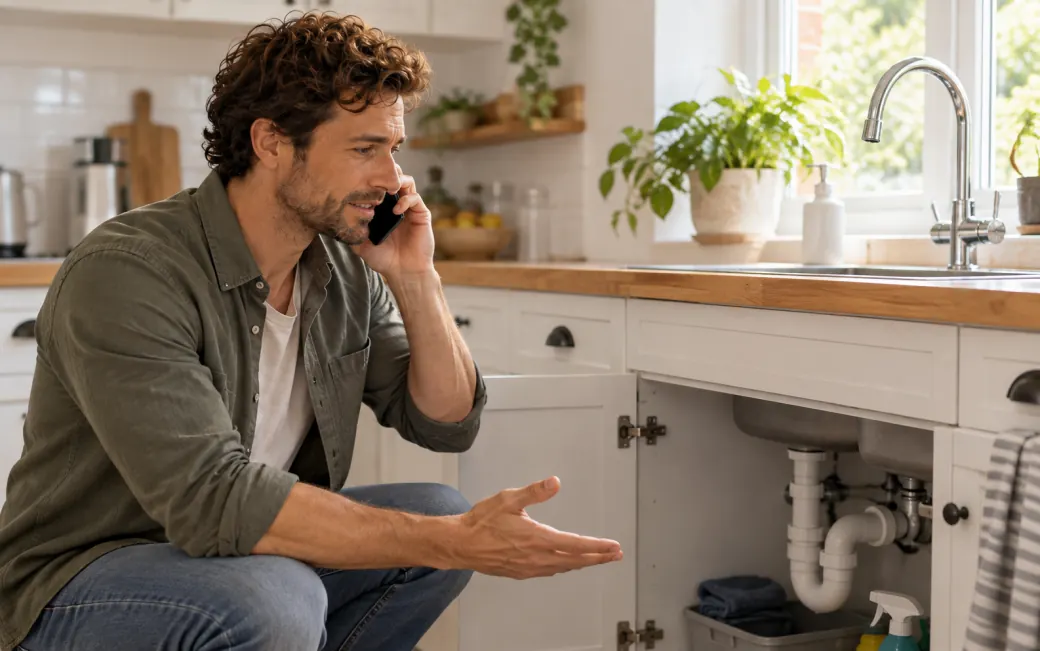
Calling a plumber dialogue in English: four levels
The same call, four ways. Each dialogue follows the lesson's five steps and uses words from that level's word list.
Starter · A1–A2
- Plumber:Hello, plumbing services — what seems to be the trouble?
- You:Hi! I have a leak. The pipe under my kitchen sink is leaking.
- Plumber:OK. What's your address?
- You:12 Oak Street.
- Plumber:I can come this afternoon, at 2. Is that OK?
- You:Yes, this afternoon is good.
- Plumber:So, a leak under the kitchen sink, at 12 Oak Street, at 2. Is that right?
- You:Yes, that's right. How much is it?
- Plumber:It's $90 for the visit, plus parts.
- You:OK. Can I pay by card? Thanks!
Conversational · A2–B1
- Plumber:Hello, plumbing services — what seems to be the trouble?
- You:Hi — my bathroom faucet won't stop dripping, and now there's water underneath the sink too.
- Plumber:Is it dripping steadily, or just now and then?
- You:Steadily — I can hear it all night. I'm at 48 Elm Street, apartment 3B.
- Plumber:I could come tomorrow between 8 and 10. Does that suit you?
- You:That suits me fine.
- Plumber:So: a dripping faucet and a leak under the bathroom sink, at 48 Elm, 3B, tomorrow from 8 to 10?
- You:That's correct. What do you charge?
- Plumber:$75 for the visit, and most faucet repairs are under $150 in total.
- You:OK, card's fine. I appreciate it!
Confident · B1–B2
- Plumber:Hello, plumbing services — what seems to be the trouble?
- You:Hi — I've got a leak at a joint under the kitchen sink. I think the seal has gone. I've managed to isolate it by closing the shutoff valve, but I don't want it to escalate.
- Plumber:Smart move. What's the address?
- You:22 Maple Avenue.
- Plumber:I can be there at 1 today.
- You:1 o'clock works.
- Plumber:So: a leaking joint under the kitchen sink, water shut off at the valve, 22 Maple Avenue, 1 p.m.?
- You:That's right. How do you charge — hourly, or a flat rate? And are parts extra?
- Plumber:$95 an hour, with a one-hour minimum, and parts are extra.
- You:Fine. I'll pay by card — could you email me a receipt? I appreciate it.
Natural · B2–C1
- Plumber:Hello, plumbing services — what seems to be the trouble?
- You:Hi — it's not good. A pipe under my sink went from a trickle to full-on gushing in about an hour.
- Plumber:Have you shut off the water? Where are you?
- You:Yep, at the main valve. I'm at 48 Elm Street, 3B.
- Plumber:OK. I can be there in 45 minutes. Does that work?
- You:Perfect — the sooner the better.
- Plumber:So: a burst pipe under the sink, the water's off, 48 Elm, 3B?
- You:That's it. What's the damage likely to be?
- Plumber:The emergency rate is $150 for the first hour, plus parts.
- You:Fair enough. I'll tap when you're done. Thanks!
More home lessons: Try Reporting a repair, Talking to the building manager or Home insurance. Related guide: How to rehearse a phone call out loud at home.
Useful English phrases for calling a plumber
Copy these and you can explain almost any plumbing problem. Each one has a copy button.
The problem
My kitchen sink is leaking.
The toilet keeps running.
There's no water pressure.
A pipe burst.
Details
It's leaking under the sink.
It started this morning.
I've turned off the water.
Timing
Could you come today?
It's an emergency.
When's your earliest appointment?
Price
How much do you charge?
Is there a fee just to come out?
Are parts included?
What the plumber might say
Understanding the questions is half the job. These are the ones you'll hear most.
What seems to be the trouble?
Where's the leak coming from?
Can you turn off the water? — close the main valve.
I can be there by 2.
There's a $75 service fee. — a charge for coming out.
Parts are extra.
It's an emergency rate after hours. — it costs more at night or on weekends.
What you have to do
Describe the leak, give your address, agree a time, and find out the price. You finish the lesson by getting there in conversation — not by answering questions about it. The tutor never stops to correct you; the feedback appears beside your own messages, and the completion screen collects it all.
How it opens
Hello, plumbing services — what seems to be the trouble?
Spoken aloud by the tutor playing the plumber.
The 5 steps that finish it
A step clears when you say the thing that clears it. The steps are identical at all four levels — only the example line fades, and at Natural there is none at all.
- 01
Describe the problem
Say what the problem is.
“Hello! There's a leak under the sink.”
- 02
Give your address
Give your address.
“I'm on Park Street — it's in the kitchen.”
- 03
Agree a time
Say if that time suits you.
“This afternoon is fine, thanks.”
- 04
Check the details
Check the details are right.
“Yes, that's right.”
- 05
Sort the price
Say how you'd like to pay, and finish.
“By card, please. Thanks for coming!”
The words, at all four levels
The same room and the same steps, four vocabularies. These are the words the lesson listens for and scores you on — with what each one means and how it sounds when you are talking to the plumber.
Starter
A1 – A2Simple, everyday words with a full hint on every step.
- leak
- water escaping where it shouldn't
- “There's a leak under the sink.”
- sink
- the basin where you wash things
- “It's under the kitchen sink.”
- pipe
- a tube that carries water
- “I think it's the pipe.”
- kitchen
- the room where you cook
- “It's in the kitchen.”
- street
- a road with houses on it
- “I'm on Park Street.”
- afternoon
- the part of the day after midday
- “This afternoon is fine.”
- much
- used to ask the price — 'how much'
- “How much is it?”
- right
- correct
- “Yes, that's right.”
- card
- a bank card you pay with
- “By card, please.”
- thanks
- a short way to say thank you
- “Thanks for coming.”
Conversational
A2 – B1Common words at a natural pace, with hints to lean on.
- dripping
- letting water fall in small drops
- “The tap keeps dripping.”
- tap
- the fitting that releases water
- “The tap keeps dripping.”
- steadily
- at a constant rate
- “It's leaking steadily now.”
- underneath
- below something
- “It's underneath the sink.”
- postcode
- the code identifying your area
- “The postcode is SW1 2AB.”
- suits
- is convenient for you
- “This afternoon suits me.”
- callout
- a visit made in response to a request
- “What's the callout fee?”
- correct
- right, with no mistakes
- “Yes, that's correct.”
- appreciate
- to be grateful for something
- “I appreciate you fitting me in.”
- cheers
- informal thanks
- “Cheers for that!”
Confident
B1 – B2Richer, more specific words, with only light hints.
- seal
- the part that stops water escaping
- “I think the seal has failed.”
- joint
- where two pipes connect
- “It's leaking from the joint.”
- isolate
- to shut off the water supply
- “Should I isolate the water?”
- valve
- the control that stops water flow
- “Where's the isolation valve?”
- escalate
- to get worse over time
- “I'd rather it didn't escalate.”
- hourly
- charged by the hour
- “Is it an hourly rate?”
- parts
- the components needed for a repair
- “Would parts be extra?”
- sorted
- arranged and settled
- “That's sorted, thanks.”
- appreciate
- to be grateful for
- “I'd appreciate that.”
- receipt
- the printed proof of payment
- “Could I get a receipt?”
Natural
B2 – C1Advanced, idiomatic words — no hints at all.
- gushing
- flowing out fast and heavily
- “It's not gushing, just steady.”
- trickle
- a thin, slow flow of liquid
- “It's more of a trickle, really.”
- stopcock
- the main tap that shuts off a home's water
- “I've found the stopcock.”
- bodge
- a rough temporary fix (informal)
- “I've done a bodge with tape.”
- sharpish
- quickly, without delay (informal)
- “If you could come sharpish.”
- damage
- the cost — 'what's the damage?' (informal)
- “What's the damage likely to be?”
- tap
- to pay by touching your card
- “I'll just tap on the day.”
- obliged
- grateful for a favour
- “Much obliged, thank you.”
- sorted
- dealt with and settled
- “Great, we're sorted.”
- cheers
- informal thanks
- “Cheers, appreciated.”
Calling a plumber in English: FAQ
How do you describe a plumbing problem in English?
Say what's wrong and where: "My kitchen sink is leaking underneath, and there's water on the floor." Say when it started, and whether you've turned off the water.
Is it "faucet" or "tap"?
"Faucet" is American English; in the UK, people say "tap". The main water shutoff is the "main valve" in the US, and often the "stopcock" in the UK.
What should you ask a plumber about the price?
Ask "How do you charge — hourly or a flat rate?", "Is there a service fee?" and "Are parts extra?" Agreeing on the price before they start avoids surprises.
What does "the toilet keeps running" mean?
It means water keeps flowing into the toilet after you flush, so it doesn't stop. It's a common problem, and an easy way to describe it.
What English level do I need to call a plumber?
A1 is enough. The Starter dialogue above uses only basic words like "leak", "sink" and "afternoon". Higher levels add more precise phrases — "I've isolated it at the valve", "from a trickle to gushing" — but the steps are the same.
How can I practice calling a plumber in English?
Read the dialogue for your level out loud, then practice it in the free lesson with an AI plumber. In the lesson you speak or type your way through all five steps and get corrections beside each message, without being interrupted.
More Home & Living lessons
- Renting an apartment
- Reporting a repair
- Getting internet installed
- Moving day
- Furniture delivery
- Meeting a neighbour
- Talking to the building manager
- Setting up utilities
- Home insurance