English speaking lesson · Everyday Life
At the hairdresser
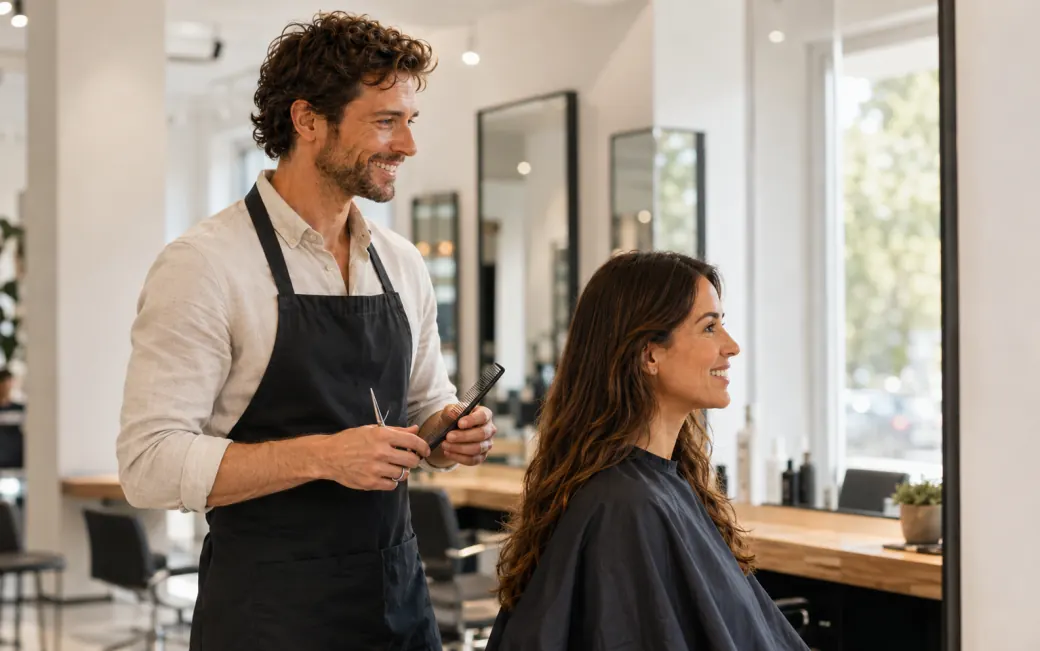
You're in the chair at the hairdresser's, deciding what you'd like done. You practice it as a real conversation, at whichever of the four levels fits you — the room and the steps stay the same, only the words get harder.
A hairdresser's chair · you talk to the hairdresser
Free plan: this lesson is free to play at every level, with 10 messages a day. No card needed. The Learning Plan makes messages unlimited — $1.99 a month or $14.99 a year, with a 7-day money-back guarantee.
What you have to do
Say what cut you'd like, give a style detail, say the length, and finish up. You finish the lesson by getting there in conversation — not by answering questions about it. The tutor never stops to correct you; the feedback appears beside your own messages, and the completion screen collects it all.
How it opens
Hi! What are we doing for you today?
Spoken aloud by the tutor playing the hairdresser.
The 5 steps that finish it
A step clears when you say the thing that clears it. The steps are identical at all four levels — only the example line fades, and at Natural there is none at all.
- 01
Say what you're after
Say what kind of cut you'd like.
“Hi! I'd like a haircut, please.”
- 02
Give a style detail
Say a detail about the style you'd like.
“Could I get a fringe too?”
- 03
Say the length
Say how much you'd like taken off.
“Just a little off, please — keep it fairly long.”
- 04
Check the plan
Check the plan sounds good.
“Yes, that sounds good.”
- 05
Finish up
Say if you're happy, and how you'd like to pay.
“I'm very happy with it — by card, please!”
The words, at all four levels
The same room and the same steps, four vocabularies. These are the words the lesson listens for and scores you on — with what each one means and how it sounds when you are talking to the hairdresser.
Starter
A1 – A2Simple, everyday words with a full hint on every step.
- haircut
- a cut to your hair
- “I'd like a haircut.”
- short
- not long
- “Short at the back, please.”
- long
- not short
- “Keep it fairly long.”
- fringe
- hair cut short over the forehead
- “Could I get a fringe?”
- wash
- to clean with water
- “Could I get a wash first?”
- little
- a small amount
- “Just a little off, please.”
- much
- used to ask the price — 'how much'
- “How much is it?”
- please
- a polite word when you ask
- “A haircut, please.”
- happy
- pleased with something
- “I'm very happy with it.”
- card
- a bank card you pay with
- “By card, please.”
Conversational
A2 – B1Common words at a natural pace, with hints to lean on.
- trim
- a light cut, taking a little off
- “Just a trim, please.”
- layers
- different lengths cut through the hair
- “Could you add some layers?”
- shape
- the overall form of the cut
- “I'd like to keep the shape simple.”
- inches
- a unit used to measure length
- “About two inches off, please.”
- roughly
- approximately
- “Roughly two inches, please.”
- sounds
- used before saying how an idea seems
- “That sounds great.”
- everything
- all of it — 'is that everything?'
- “That's everything, thanks.”
- total
- the full amount to pay
- “What's the total?”
- appreciate
- to be grateful for
- “I really appreciate it.”
- cheers
- informal thanks
- “Cheers for that!”
Confident
B1 – B2Richer, more specific words, with only light hints.
- restyle
- a significant change to a hairstyle
- “I'm after a bit of a restyle.”
- texture
- the feel and structure of hair
- “My hair has quite a lot of texture.”
- blend
- to smoothly combine different lengths
- “Could you blend it in at the sides?”
- tapered
- gradually narrowing
- “A tapered finish would be great.”
- volume
- the fullness or thickness of hair
- “I'd like to keep some volume on top.”
- maintain
- to keep something as it is
- “I'd like to maintain the length overall.”
- altogether
- in total — 'how much altogether'
- “How much altogether?”
- receipt
- the printed proof of payment
- “Could I get a receipt?”
- sorted
- arranged and settled
- “That's sorted, thanks.”
- appreciate
- to be grateful for
- “I'd appreciate that.”
Natural
B2 – C1Advanced, idiomatic words — no hints at all.
- tidy
- to neaten something (informal) — 'a tidy up'
- “Just a tidy up, really.”
- chop
- a short cut (informal)
- “I fancy a bit of a chop, honestly.”
- faff
- unnecessary fuss (informal)
- “No faff, just keep it simple.”
- ropey
- not looking great (informal)
- “It's looking a bit ropey, to be honest.”
- spruce
- to freshen up (informal)
- “It just needs a spruce, really.”
- blend
- to smoothly combine different lengths
- “If you could blend the sides in.”
- tap
- to pay by touching your card
- “I'll just tap.”
- cheers
- informal thanks
- “Cheers, appreciated.”
- sorted
- dealt with and settled
- “Perfect, we're sorted.”
- obliged
- grateful for a favour
- “Much obliged, thank you.”
More Everyday Life lessons
- Grocery shopping
- Making plans with a friend
- At the post office
- Missed delivery
- At the dry cleaners
- Joining a gym
- Locked out