English speaking lesson · Everyday Life
Locked out
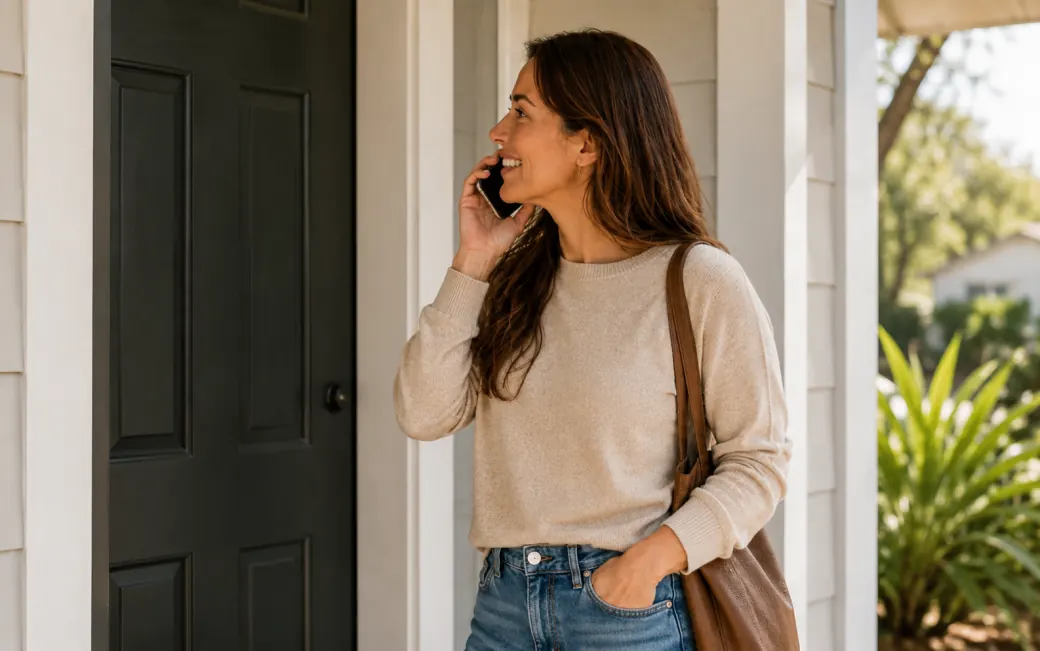
You've locked yourself out, and you're calling a local locksmith for help. You practice it as a real conversation, at whichever of the four levels fits you — the room and the steps stay the same, only the words get harder.
A phone call to a locksmith · you talk to the locksmith
Free plan: this lesson is free to play at every level, with 10 messages a day. No card needed. The Learning Plan makes messages unlimited — $1.99 a month or $14.99 a year, with a 7-day money-back guarantee.
What you have to do
Report you're locked out, give your address, agree a time, and sort the price. You finish the lesson by getting there in conversation — not by answering questions about it. The tutor never stops to correct you; the feedback appears beside your own messages, and the completion screen collects it all.
How it opens
Hi there, locksmith service — what's happened?
Spoken aloud by the tutor playing the locksmith.
The 5 steps that finish it
A step clears when you say the thing that clears it. The steps are identical at all four levels — only the example line fades, and at Natural there is none at all.
- 01
Say you're locked out
Say you're locked out.
“Hi! I'm locked out of my home — I lost my key.”
- 02
Give your address
Give your address.
“This is my address, near the park.”
- 03
Agree a time
Say if that timing works for you.
“Twenty minutes is fine, thanks.”
- 04
Check the details
Check the details are right.
“Yes, that's right.”
- 05
Sort the price
Say how you'd like to pay, and finish.
“By card, please. Thanks for coming!”
The words, at all four levels
The same room and the same steps, four vocabularies. These are the words the lesson listens for and scores you on — with what each one means and how it sounds when you are talking to the locksmith.
Starter
A1 – A2Simple, everyday words with a full hint on every step.
- locked
- unable to open, closed with a lock
- “I'm locked out.”
- out
- outside, unable to get in
- “I'm locked out.”
- door
- what you open to enter a room
- “The door is locked.”
- home
- where you live
- “This is my home.”
- key
- what opens a lock
- “I lost my key.”
- minutes
- a short unit of time
- “Twenty minutes, please.”
- much
- used to ask the price — 'how much'
- “How much is it?”
- please
- a polite word when you ask
- “Twenty minutes, please.”
- card
- a bank card you pay with
- “By card, please.”
- thanks
- a short way to say thank you
- “Thanks for coming.”
Conversational
A2 – B1Common words at a natural pace, with hints to lean on.
- stuck
- unable to move or get in
- “I'm stuck outside my flat.”
- entrance
- the way into a building
- “The entrance is round the side.”
- arrive
- to reach a place
- “How soon can you arrive?”
- shortly
- very soon
- “Could you come shortly?”
- works
- is acceptable, is fine
- “That works for me.”
- correct
- right, with no mistakes
- “Yes, that's correct.”
- estimate
- a rough guess of cost
- “Could I get an estimate?”
- altogether
- in total — 'how much altogether'
- “How much altogether?”
- appreciate
- to be grateful for
- “I really appreciate it.”
- cheers
- informal thanks
- “Cheers for coming out!”
Confident
B1 – B2Richer, more specific words, with only light hints.
- premises
- a building and its surrounding land
- “I'm locked out of the premises.”
- verify
- to confirm something is true
- “Would you need to verify I live here?”
- identification
- official proof of who you are
- “I've got identification with me.”
- access
- the way to get into something
- “How would you gain access?”
- non-destructive
- without causing damage
- “I'd prefer a non-destructive method.”
- callout
- a visit made in response to a request
- “What's the callout fee?”
- altogether
- in total — 'how much altogether'
- “How much altogether?”
- receipt
- the printed proof of payment
- “Could I get a receipt?”
- sorted
- arranged and settled
- “That's sorted, thanks.”
- appreciate
- to be grateful for
- “I'd appreciate that.”
Natural
B2 – C1Advanced, idiomatic words — no hints at all.
- shut
- locked outside (informal) — 'shut out'
- “I've properly shut myself out.”
- dodgy
- unreliable or suspicious (informal)
- “The lock's been a bit dodgy lately.”
- prise
- to force something open carefully
- “Would you need to prise it open?”
- fumble
- to handle something clumsily
- “I did fumble the keys earlier.”
- sort
- to deal with and resolve (informal)
- “Hoping you can sort it quickly.”
- tap
- to pay by touching your card
- “I'll just tap when you're done.”
- cheers
- informal thanks
- “Cheers, appreciated.”
- sorted
- dealt with and settled
- “Perfect, we're sorted.”
- obliged
- grateful for a favour
- “Much obliged, thank you.”
- callout
- a visit made in response to a request
- “What's the callout like?”
More Everyday Life lessons
- Grocery shopping
- Making plans with a friend
- At the post office
- Missed delivery
- At the dry cleaners
- At the hairdresser
- Joining a gym