English speaking lesson · Everyday Life
How to Send a Package at the Post Office in English: Phrases, Dialogues & Speaking Practice
Last updated:
At the post office in English, say what you're sending and where: "Hi, I'd like to send this package to Canada." The clerk will usually weigh it, ask whether you want standard or express shipping, and tell you the price. Below you'll find a full clerk–customer dialogue at four levels (A1 to C1), the phrases worth copying, and a free lesson where you practice it with an AI post office clerk.
The dialogues use American English ($). British differences are covered in the FAQ.
You're at the post office counter, ready to send a parcel. You practice it as a real conversation with a free AI English tutor, at whichever of the four levels fits you — the room and the steps stay the same, only the words get harder.
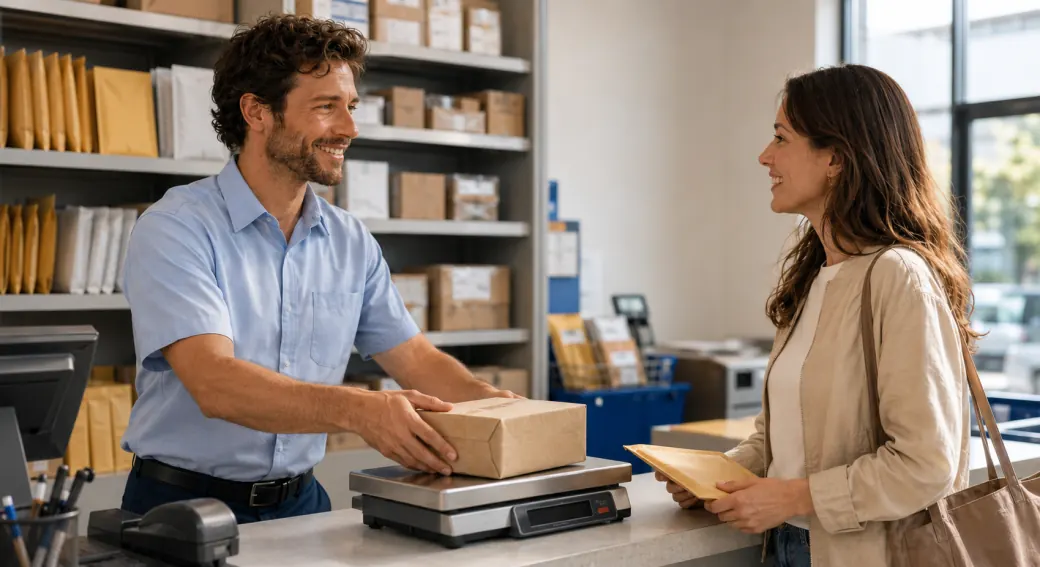
A post office counter · you talk to the post office clerk
Free plan: this lesson is free to play at every level, with 10 messages a day, shared across Free Talk and all lessons, corrections on 3 messages per conversation, and standard support. No card needed. The Learning Plan adds unlimited messages and corrections, and priority support — from $1.99 a month or $14.99 a year up to $9.99 a month or $49.99 a year, depending on your region, with a 7-day money-back guarantee. New subscribers get a 7-day free trial of the Learning Plan.
Post office dialogue in English: four levels
The same visit, four ways. Each dialogue follows the lesson's five steps and uses words from that level's word list.
Starter · A1–A2
- Clerk:Morning! What can I help you send today?
- You:Hi! I want to send this box, please.
- Clerk:Sure. Where is it going?
- You:To Canada. Here's the address.
- Clerk:OK. Fast or slow?
- You:Slow, please. It's cheaper.
- Clerk:OK. So, one box to Canada, slow. Is that right?
- You:Yes. How much is it?
- Clerk:It's $25.
- You:By card, please. Thanks!
Conversational · A2–B1
- Clerk:Morning! What can I help you send today?
- You:Morning! I'd like to send this package.
- Clerk:Of course. Where's it going?
- You:Overseas — to my sister in Germany.
- Clerk:Would you like standard or express?
- You:How long does standard take to deliver? I'll probably go with that.
- Clerk:About two weeks. Express is three to five days.
- You:Standard is fine. Can it be tracked and insured?
- Clerk:Yes — tracking is included, and insurance is $4. So: standard to Germany, tracked and insured. Is that everything?
- You:That's everything. What's the total?
- Clerk:$46.
- You:Card, please. Thanks!
Confident · B1–B2
- Clerk:Morning! What can I help you send today?
- You:Morning — I'd like to send a shipment of books.
- Clerk:Sure. Where to?
- You:To Tokyo. Do I need to fill out a customs form?
- Clerk:Yes, for anything international — just list what's inside and the value. Let me check the weight and dimensions. … 8 pounds, 14 by 10 by 6. Standard or priority?
- You:Priority, please — and could it require a signature on delivery?
- Clerk:Of course. Priority has a guaranteed delivery date. So: priority to Tokyo, with signature confirmation.
- You:That's right. How much is that altogether?
- Clerk:$92 altogether.
- You:Card's fine — and a receipt, please. I appreciate it.
Natural · B2–C1
- Clerk:Morning! What can I help you send today?
- You:Morning! I've got a fairly fragile consignment — two framed prints.
- Clerk:OK. Where's it headed?
- You:Lisbon. I'll fill out the customs declaration — they're gifts, so the value's low.
- Clerk:Fine. Standard or express?
- You:Express. And I'd like it insured for the full value and tracked door to door.
- Clerk:Got it. It's under the weight limit, so it doesn't need to go as freight. Express to Lisbon, insured and tracked.
- You:Good to hear. What's the damage?
- Clerk:$78.
- You:I'll tap. Thanks!
More everyday lessons: Try Missed delivery, Grocery shopping or At the dry cleaners.
Useful English phrases for the post office
Copy these and you can send almost anything from any post office. Each one has a copy button.
Sending
I'd like to send this package to Canada.
How much is it to send a letter to Mexico?
Do you sell boxes?
I'd like to buy some stamps.
Options
What's the cheapest option?
How long will it take?
Can it be tracked?
Can I insure it?
International
Do I need a customs form?
It's a gift. — useful on customs forms.
Paying
How much is that?
Can I pay by card?
Could I get a receipt with the tracking number?
What the clerk might say
Understanding the questions is half the job. These are the ones you'll hear most.
Where's it going?
Is there anything fragile, liquid or dangerous inside?
Standard or express?
It'll take about two weeks.
You'll need to fill out a customs form.
Would you like insurance?
Here's your tracking number.
What you have to do
Say what you're sending, where it's going, choose a delivery speed, and pay. You finish the lesson by getting there in conversation — not by answering questions about it. The tutor never stops to correct you; the feedback appears beside your own messages, and the completion screen collects it all.
How it opens
Morning! What can I help you send today?
Spoken aloud by the tutor playing the post office clerk.
The 5 steps that finish it
A step clears when you say the thing that clears it. The steps are identical at all four levels — only the example line fades, and at Natural there is none at all.
- 01
Say what you're sending
Say what you'd like to send.
“Hi! I'd like to send a parcel — it's in a small box.”
- 02
Say where it's going
Say where it's going.
“Here's the address — it's going to another country.”
- 03
Choose a speed
Say whether you'd like standard or express.
“The fast way, please.”
- 04
Check the order
Check the order is right, and ask how much it costs.
“Yes, that's everything. How much is it?”
- 05
Pay and finish
Say how you'd like to pay, and finish politely.
“By card, please!”
The words, at all four levels
The same room and the same steps, four vocabularies. These are the words the lesson listens for and scores you on — with what each one means and how it sounds when you are talking to the post office clerk.
Starter
A1 – A2Simple, everyday words with a full hint on every step.
- parcel
- a wrapped package
- “I'd like to send a parcel.”
- send
- to have something delivered
- “I'd like to send this.”
- box
- a container things come in
- “It's in a small box.”
- address
- where someone lives, written out
- “Here's the address.”
- country
- a nation, like France or Spain
- “It's going to another country.”
- fast
- quick
- “The fast way, please.”
- slow
- not fast
- “The slow way is fine.”
- much
- used to ask the price — 'how much'
- “How much is it?”
- please
- a polite word when you ask
- “The fast way, please.”
- card
- a bank card you pay with
- “By card, please.”
Conversational
A2 – B1Common words at a natural pace, with hints to lean on.
- package
- something sent by post
- “I'd like to send a package.”
- deliver
- to bring something to its destination
- “How long to deliver it?”
- overseas
- to another country
- “It's going overseas.”
- tracked
- able to be followed online
- “Could I get it tracked?”
- insured
- protected in case of loss or damage
- “Should it be insured too?”
- standard
- the normal, regular option
- “Standard delivery is fine.”
- express
- a faster, more expensive option
- “Or is express much quicker?”
- everything
- all of it — 'is that everything?'
- “That's everything, thanks.”
- total
- the full amount to pay
- “What's the total?”
- cheers
- informal thanks
- “Cheers for that!”
Confident
B1 – B2Richer, more specific words, with only light hints.
- shipment
- an item or items sent together
- “This is a small shipment.”
- customs
- border checks for international goods
- “Does it need a customs form?”
- weight
- how heavy something is
- “What's the weight limit?”
- dimensions
- the size measurements of something
- “Do the dimensions matter much?”
- signature
- a required proof of receipt
- “Should it need a signature?”
- guaranteed
- certain to happen by a set time
- “Is next-day guaranteed?”
- altogether
- in total — 'how much altogether'
- “How much altogether?”
- receipt
- the printed proof of payment
- “Could I get a receipt?”
- sorted
- arranged and settled
- “That's sorted, thanks.”
- appreciate
- to be grateful for
- “I'd appreciate that.”
Natural
B2 – C1Advanced, idiomatic words — no hints at all.
- consignment
- a batch of goods sent together
- “It's a small consignment, really.”
- freight
- goods transported in bulk
- “Is this handled as freight or post?”
- declaration
- an official statement of contents
- “Do I need a customs declaration?”
- insured
- protected in case of loss or damage
- “Best to have it insured, I think.”
- tracked
- able to be followed online
- “Tracked would put my mind at ease.”
- damage
- the cost — 'what's the damage?' (informal)
- “What's the damage for that?”
- tap
- to pay by touching your card
- “I'll just tap.”
- cheers
- informal thanks
- “Cheers, appreciated.”
- sorted
- dealt with and settled
- “Perfect, we're sorted.”
- obliged
- grateful for a favour
- “Much obliged, thank you.”
At the post office in English: FAQ
How do you send a package at the post office in English?
Say what you're sending and where: "I'd like to send this package to Canada." Then choose a speed, ask "Can it be tracked?", and pay.
Is it "package" or "parcel"?
"Package" is more common in American English; in the UK, people usually say "parcel". Americans also say "mail" where British people often say "post".
What is a customs form?
When you send something to another country, a customs form lists what's inside and how much it's worth. The post office will tell you which form you need.
What's the difference between standard and express shipping?
Standard is cheaper but slower. Express costs more and arrives faster, often with a delivery guarantee. Ask "How long will it take?" for each option.
What English level do I need at the post office?
A1 is enough. The Starter dialogue above uses only basic words like "send", "box" and "address". Higher levels add more precise phrases — "do I need a customs form?", "tracked door to door" — but the steps are the same.
How can I practice a post office conversation in English?
Read the dialogue for your level out loud, then practice it in the free lesson with an AI post office clerk. In the lesson you speak or type your way through all five steps and get corrections beside each message, without being interrupted.
More Everyday Life lessons
- Grocery shopping
- Making plans with a friend
- Missed delivery
- At the dry cleaners
- At the hairdresser
- Joining a gym
- Locked out