English speaking lesson · Health & Wellbeing
Eye test
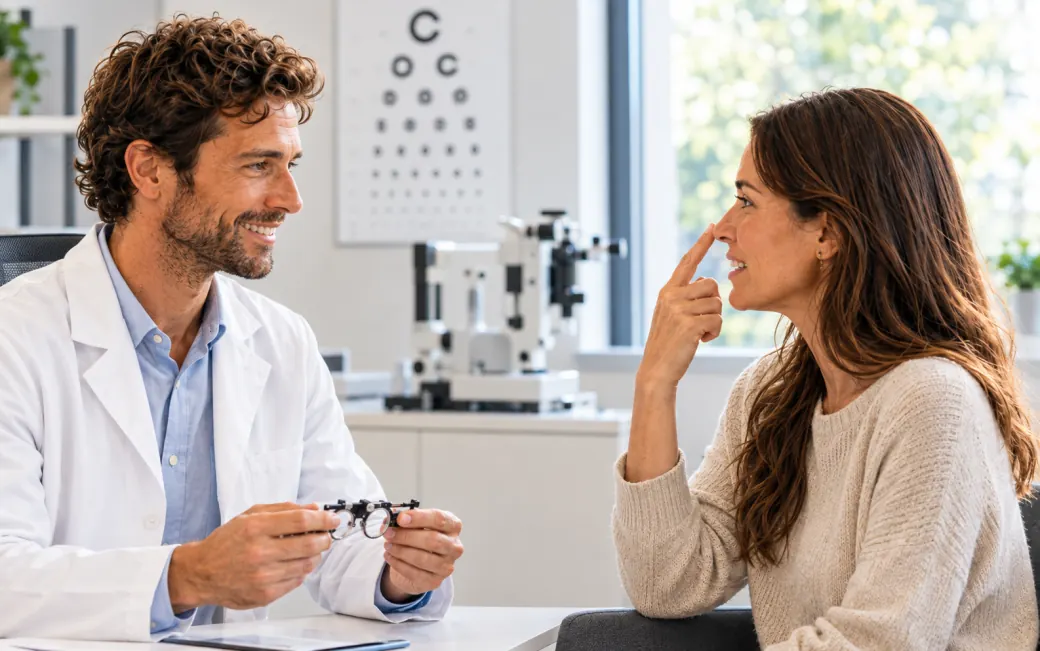
You're at the optician's for an eye test, explaining how your eyesight has been. You practice it as a real conversation, at whichever of the four levels fits you — the room and the steps stay the same, only the words get harder.
The optician's · you talk to the optician
Free plan: this lesson is free to play at every level, with 10 messages a day. No card needed. The Learning Plan makes messages unlimited — $1.99 a month or $14.99 a year, with a 7-day money-back guarantee.
What you have to do
Explain what's been happening with your eyesight, answer a couple of questions, and get a recommendation. You finish the lesson by getting there in conversation — not by answering questions about it. The tutor never stops to correct you; the feedback appears beside your own messages, and the completion screen collects it all.
How it opens
Hi there! Please, sit down — what's brought you in today?
Spoken aloud by the tutor playing the optician.
The 5 steps that finish it
A step clears when you say the thing that clears it. The steps are identical at all four levels — only the example line fades, and at Natural there is none at all.
- 01
Explain the problem
Say hello, and explain what's been happening with your eyesight.
“Hi — things have been looking a bit blurry.”
- 02
Say how long
Say how long you've noticed the problem.
“For about a month now.”
- 03
Give more detail
Say when it's worse — screens, reading, or driving.
“It's worse with a screen, and reading small text.”
- 04
Check everything's covered
Check everything's covered, and mention anything else.
“No, that's everything, thanks.”
- 05
Get a recommendation
Listen to the recommendation, and say if you'd like to look at frames.
“Okay, thank you — do I need glasses?”
The words, at all four levels
The same room and the same steps, four vocabularies. These are the words the lesson listens for and scores you on — with what each one means and how it sounds when you are talking to the optician.
Starter
A1 – A2Simple, everyday words with a full hint on every step.
- eyes
- the parts of your body you see with
- “My eyes feel tired.”
- blurry
- not clear, hard to see well
- “Things look blurry.”
- see
- to use your eyes to look
- “I can't see well.”
- month
- a period of about thirty days
- “For about a month now.”
- screen
- the part of a phone or computer you look at
- “It's worse with a screen.”
- read
- to look at and understand words
- “It's hard to read small text.”
- glasses
- lenses you wear to help you see
- “Do I need glasses?”
- test
- a check of how well you see
- “Thanks for the test.”
- please
- a polite word when you ask
- “Glasses, please.”
- thanks
- a short way to say thank you
- “Thanks for your help.”
Conversational
A2 – B1Common words at a natural pace, with hints to lean on.
- eyesight
- your ability to see
- “My eyesight's been a bit off.”
- strain
- tiredness from overusing your eyes
- “I've had some eye strain.”
- distance
- how far away something is
- “It's worse at a distance.”
- headaches
- pains in the head
- “I've had a few headaches too.”
- focus
- to make something clear and sharp
- “It takes a while to focus.”
- gradually
- slowly, over time
- “It's happened gradually.”
- prescription
- the details of your correct lenses
- “Has my prescription changed?”
- reading
- glasses used only for close-up text
- “Would reading glasses help?”
- appointment
- a planned meeting, like with an optician
- “Thanks for the appointment today.”
- appreciate
- to be grateful for
- “I appreciate the check.”
Confident
B1 – B2Richer, more specific words, with only light hints.
- astigmatism
- a common cause of blurred vision
- “Could it be astigmatism?”
- deteriorated
- become worse over time
- “It's deteriorated slightly.”
- peripheral
- at the edge of your field of vision
- “My peripheral vision seems fine.”
- correction
- an adjustment to fix your vision
- “Would I need much correction?”
- varifocal
- lenses that adjust for near and far
- “Would a varifocal lens suit me?”
- prolonged
- lasting for a long time
- “It's mostly prolonged screen use.”
- referral
- being sent to a specialist
- “Would that need a referral?”
- frames
- the part of glasses that holds the lenses
- “Could I look at frames after?”
- adjustment
- a period of getting used to something
- “Is there an adjustment period?”
- appreciate
- to be grateful for
- “I'd appreciate that.”
Natural
B2 – C1Advanced, idiomatic words — no hints at all.
- squint
- to narrow your eyes to see better
- “I've noticed myself starting to squint.”
- hazy
- unclear, as if through mist
- “Everything's a bit hazy lately.”
- creeping
- happening slowly and gradually
- “It's been a creeping thing.”
- strained
- tired from overuse
- “My eyes feel strained by evening.”
- tweak
- a small adjustment
- “Probably just needs a small tweak.”
- juggle
- to manage several things at once
- “I juggle screens most of the day.”
- browse
- to look through options casually
- “I'll browse the frames after.”
- settle
- to get used to something over time
- “It should settle after a week or two.”
- obliged
- grateful for a favour
- “Much obliged, thank you.”
- sorted
- dealt with and settled
- “Great, we're sorted.”
More Health & Wellbeing lessons
- Doctor's appointment
- Pharmacy & symptoms
- Booking a doctor's appointment
- Dentist appointment
- Physiotherapy session
- Blood test
- Vaccination
- Personal trainer session
- Therapist check-in