English speaking lesson · Learning & Leisure
How to Buy Show Tickets in English: Phrases, Dialogues & Speaking Practice
Last updated:
To buy tickets in English, say what show you want to see, when, and how many: "Hi, could I get two tickets for the show on Saturday night?" The box office assistant will usually ask where you'd like to sit, tell you the price, and ask how you'd like to get the tickets. Below you'll find a full dialogue at four levels (A1 to C1), the phrases worth copying, and a free lesson where you practice it with an AI box office assistant.
The dialogues use American English ($). British differences are covered in the FAQ.
You're at a theatre box office buying tickets for a show. You practice it as a real conversation with a free AI English tutor, at whichever of the four levels fits you — the room and the steps stay the same, only the words get harder.
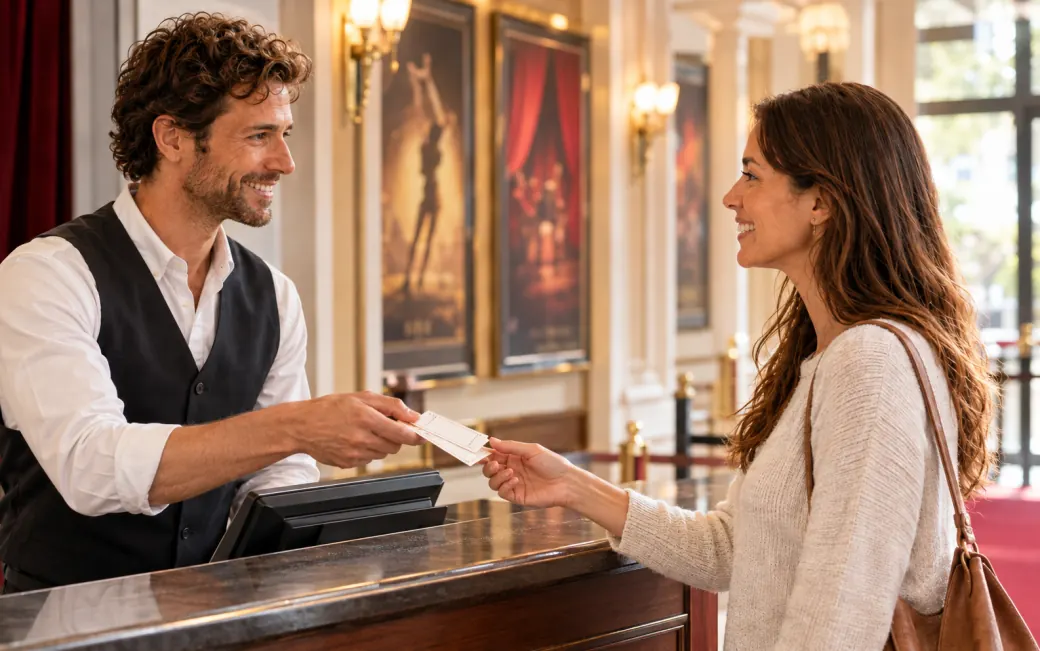
A theatre box office · you talk to the box office assistant
Free plan: this lesson is free to play at every level, with 10 messages a day, shared across Free Talk and all lessons, corrections on 3 messages per conversation, and standard support. No card needed. The Learning Plan adds unlimited messages and corrections, and priority support — from $1.99 a month or $14.99 a year up to $9.99 a month or $49.99 a year, depending on your region, with a 7-day money-back guarantee. New subscribers get a 7-day free trial of the Learning Plan.
Buying tickets dialogue in English: four levels
The same visit, four ways. Each dialogue follows the lesson's five steps and uses words from that level's word list.
Starter · A1–A2
- Box office:Hello! What can I get you tickets for?
- You:Hi! I want tickets for the dance show, please.
- Box office:Sure. Which day?
- You:Saturday, please.
- Box office:How many tickets, and where do you want to sit?
- You:Two seats, near the front.
- Box office:OK. Two seats in row C on Saturday. Is that right?
- You:Yes. How much is it?
- Box office:It's $80 for two. How do you want to pay?
- You:By card, please. Can you send the tickets by email?
Conversational · A2–B1
- Box office:Hello! What can I get you tickets for?
- You:Hi — I'd like tickets for the musical, please.
- Box office:Great choice. Which performance?
- You:Is there a matinee on Sunday? If it's available, I'd prefer the afternoon.
- Box office:Yes, there's one at 2 p.m. How many, and where would you like to sit?
- You:Three seats together, please, with a good view of the stage.
- Box office:I have three together in the middle of row F. So, three for the Sunday matinee?
- You:That's everything, yes. What's the total for the booking?
- Box office:$165 altogether. How would you like to pay?
- You:By card, and could you email the tickets to me? Thank you!
Confident · B1–B2
- Box office:Hello! What can I get you tickets for?
- You:Hi — I'm hoping to see the new production of Hamlet.
- Box office:Lovely. Which date were you thinking?
- You:Do you have any availability next Friday evening?
- Box office:A little. There are premium seats in the orchestra, or cheaper ones in the balcony with a restricted view.
- You:How restricted is the view? If it's just a pillar at the side, I don't mind.
- Box office:It's a pillar on the left — you'll miss very little. So that's two balcony seats for Friday?
- You:That works. What's that altogether — and is there a student discount?
- Box office:$70 altogether, or $56 with a student ID.
- You:Here's my student ID. I'll pay by card and pick the tickets up here on the night. I appreciate it.
Natural · B2–C1
- Box office:Hello! What can I get you tickets for?
- You:Hi! I know it's a long shot, but the comedy show tonight — it says sold out online. Have any returns come in?
- Box office:You're in luck — two just came back. Is tonight the night you want?
- You:Tonight's the night. I'll snap them up.
- Box office:They're side seats, slightly restricted view. Still want them?
- You:Honestly, I'd sit on the roof. Side seats are fine.
- Box office:Ha! So that's two side seats for tonight's show?
- You:Yep. What's the damage?
- Box office:$90 for the pair.
- You:Totally worth it. Can I just tap my card? And could you send the tickets to my phone?
More leisure lessons: Try A museum visit, At the library or Joining a hobby group.
Useful English phrases for buying tickets
Copy these and you can book seats for any show. Each one has a copy button.
The show and date
Could I get two tickets for the musical?
Do you have anything on Saturday night?
Is there an afternoon show?
Seats
Could we sit together?
Do you have anything near the front?
Is the view OK from there?
What's the cheapest seat you have?
Price
How much is that altogether?
Is there a student discount?
Are there any fees?
Paying and getting the tickets
Can I pay by card?
Could you email me the tickets?
Can I pick them up before the show?
What the box office might say
Understanding the questions is half the job. These are the ones you'll hear most.
Which performance would you like?
How many tickets?
We only have single seats left. — seats that aren't next to each other.
It's a restricted view. — something blocks part of the stage.
That show is sold out.
There's a 20-minute intermission. — a break in the middle.
Your tickets will be at will call.
What you have to do
Say what you want to see, pick a date, choose your seats, and pay. You finish the lesson by getting there in conversation — not by answering questions about it. The tutor never stops to correct you; the feedback appears beside your own messages, and the completion screen collects it all.
How it opens
Hello! What can I get you tickets for?
Spoken aloud by the tutor playing the box office assistant.
The 5 steps that finish it
A step clears when you say the thing that clears it. The steps are identical at all four levels — only the example line fades, and at Natural there is none at all.
- 01
Say what you want to see
Say what show you'd like to see.
“Hello! Tickets for the show, please.”
- 02
Pick a date
Say which date you'd like.
“On Saturday, please.”
- 03
Choose your seats
Say how many tickets and where you'd like to sit.
“Two seats together, near the front, please.”
- 04
Check the booking
Check the booking is right, and ask the price.
“Yes, that's everything. How much is it?”
- 05
Pay and collect
Say how you'd like to pay and receive the tickets.
“By card, please — by email too!”
The words, at all four levels
The same room and the same steps, four vocabularies. These are the words the lesson listens for and scores you on — with what each one means and how it sounds when you are talking to the box office assistant.
Starter
A1 – A2Simple, everyday words with a full hint on every step.
- tickets
- passes that let you enter an event
- “Two tickets, please.”
- show
- a performance you watch
- “For the show tonight.”
- Saturday
- the sixth day of the week
- “On Saturday, please.”
- two
- the number 2
- “Two tickets, please.”
- seats
- places to sit
- “Two seats together, please.”
- front
- the part nearest the stage
- “Near the front, please.”
- much
- used to ask the price — 'how much'
- “How much is it?”
- a message sent over the internet
- “By email, please.”
- please
- a polite word when you ask
- “Two tickets, please.”
- card
- a bank card you pay with
- “By card, please.”
Conversational
A2 – B1Common words at a natural pace, with hints to lean on.
- performance
- one showing of a play or concert
- “Which performance is it?”
- available
- free to be booked
- “Is Saturday available?”
- matinee
- an afternoon performance
- “Is there a matinee?”
- stalls
- the seats on the ground floor
- “Are there stalls seats?”
- together
- next to each other
- “Two seats together, please.”
- view
- how well you can see the stage
- “Is the view good there?”
- booking
- a reservation made in advance
- “Is there a booking fee?”
- everything
- all of it — 'is that everything?'
- “That's everything, thanks.”
- total
- the full amount to pay
- “What's the total?”
- cheers
- informal thanks
- “Cheers for that!”
Confident
B1 – B2Richer, more specific words, with only light hints.
- restricted
- with a partly blocked view
- “Are any seats restricted?”
- circle
- the raised seating above the stalls
- “What about the circle?”
- premium
- the best and most expensive seats
- “Are those premium seats?”
- availability
- whether seats are free to book
- “What's the availability like?”
- concession
- a reduced price for certain people
- “Is there a concession rate?”
- interval
- the break in the middle of a show
- “Is there an interval?”
- altogether
- in total — 'how much altogether'
- “How much altogether?”
- collection
- picking tickets up in person
- “Is collection possible?”
- sorted
- arranged and settled
- “That's sorted, thanks.”
- appreciate
- to be grateful for
- “I'd appreciate that.”
Natural
B2 – C1Advanced, idiomatic words — no hints at all.
- sold
- no longer available — 'sold out'
- “Is Saturday sold out?”
- returns
- tickets given back and resold
- “Do you get many returns?”
- restricted
- with a partly blocked view
- “Nothing restricted, ideally.”
- bagged
- secured or obtained (informal)
- “Glad I bagged these.”
- snap
- to buy quickly before others (informal)
- “I'll snap those up.”
- damage
- the cost — 'what's the damage?' (informal)
- “What's the damage?”
- tap
- to pay by touching your card
- “I'll just tap.”
- obliged
- grateful for a favour
- “Much obliged, thank you.”
- sorted
- dealt with and settled
- “Great, we're sorted.”
- cheers
- informal thanks
- “Cheers, appreciated.”
Buying tickets in English: FAQ
How do you ask for tickets in English?
Say the show, the date and how many: "Hi, could I get two tickets for the show on Saturday night?" Then ask about seats and the price.
What is a "matinee"?
A matinee is an afternoon performance of a show. Tickets are sometimes cheaper than in the evening.
What does "will call" mean?
"Will call" is the desk where you pick up tickets you've already paid for, usually just before the show.
What are the British words for theater seats?
In the UK, the seats downstairs are "the stalls" (US: "the orchestra"), the balcony is often "the circle", and the break is "the interval" (US: "intermission"). British English also spells it "theatre".
What English level do I need to buy tickets?
A1 is enough. The Starter dialogue above uses only basic words like "tickets", "seats" and "front". Higher levels add more natural phrases — "how restricted is the view?", "what's the damage?" — but the steps are the same.
How can I practice buying tickets in English?
Read the dialogue for your level out loud, then practice it in the free lesson with an AI box office assistant. In the lesson you speak or type your way through all five steps and get corrections beside each message, without being interrupted.
More Learning & Leisure lessons
- At the library
- A museum visit
- Joining a class
- Joining a hobby group
- Joining a sports club
- A language exchange
- A group project