English speaking lesson · Learning & Leisure
How to Visit a Museum in English: Phrases, Dialogues & Speaking Practice
Last updated:
At a museum, say how many of you there are, buy your ticket, and ask what's worth seeing: "Just one adult, please. What would you say is the best thing to see?" The front desk will usually tell you the highlights, mention any guided tours, and give you a map. Below you'll find a full dialogue at four levels (A1 to C1), the phrases worth copying, and a free lesson where you practice it with an AI museum host.
The dialogues use American English ($). British differences are covered in the FAQ.
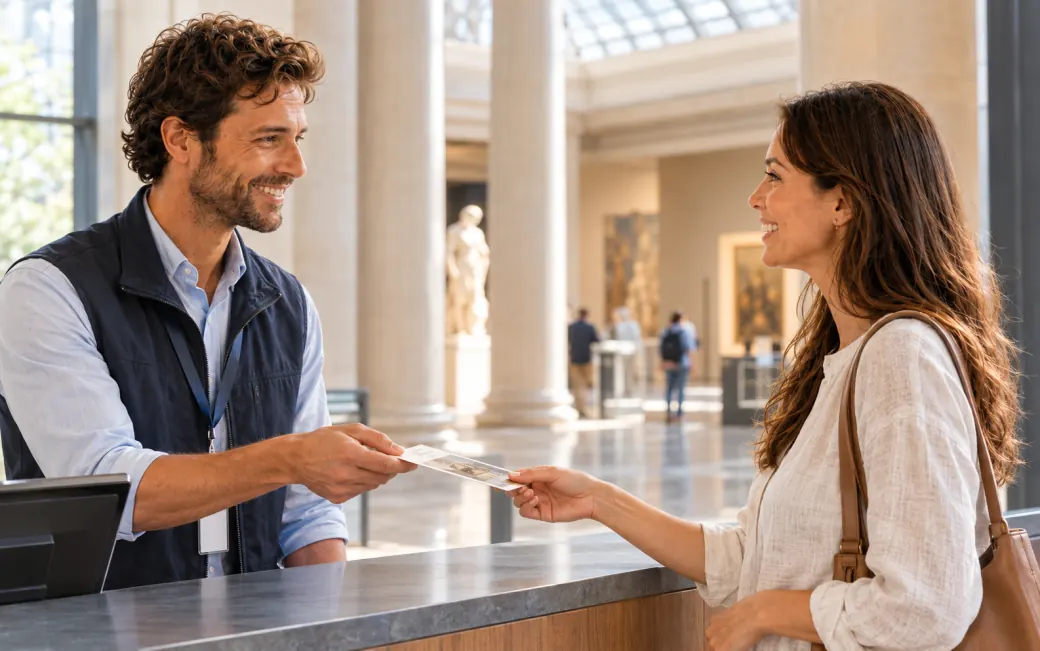
You've arrived at a museum and you're at the front desk. You practice it as a real conversation with a free AI English tutor, at whichever of the four levels fits you — the room and the steps stay the same, only the words get harder.
A museum front desk · you talk to the museum host
Free plan: this lesson is free to play at every level, with 10 messages a day, shared across Free Talk and all lessons, corrections on 3 messages per conversation, and standard support. No card needed. The Learning Plan adds unlimited messages and corrections, and priority support — from $1.99 a month or $14.99 a year up to $9.99 a month or $49.99 a year, depending on your region, with a 7-day money-back guarantee. New subscribers get a 7-day free trial of the Learning Plan.
Museum visit dialogue in English: four levels
The same visit, four ways. Each dialogue follows the lesson's five steps and uses words from that level's word list.
Starter · A1–A2
- Host:Good morning, welcome! Is it just yourself today?
- You:Yes, just one, please.
- Host:Great. A ticket is $20.
- You:OK. One ticket, please.
- Host:Here you go. Do you have any questions?
- You:What's the best thing to see in the museum?
- Host:The dinosaurs! There's also a free tour at 11. Is that a good time?
- You:Yes, 11 is a good time. I want to see the tour.
- Host:Great. Would you like a map?
- You:Yes, a map, please. Thanks!
Conversational · A2–B1
- Host:Good morning, welcome! Is it just yourself today?
- You:No, there are two of us — me and my friend.
- Host:Great. Standard entry is $18, or $25 with the new exhibition.
- You:Two standard tickets, please. Is the exhibition worthwhile?
- Host:It's good, but the main collection is just as strong. Anything you'd like to know?
- You:What are the highlights? And is there a guided tour?
- Host:Don't miss the Egyptian rooms. There's a guided tour at 2 p.m. — it lasts an hour.
- You:An hour at 2 is perfect. We'll have lunch at the café first.
- Host:Lovely. Here's a map.
- You:Thank you — I appreciate it.
Confident · B1–B2
- Host:Good morning, welcome! Is it just yourself today?
- You:Yes, just me today.
- Host:The permanent collection is free, and the temporary exhibition is $15.
- You:I'll take a ticket for the temporary exhibition, please — I hear it's very well curated.
- Host:It is. Anything else I can help with?
- You:What would you say is unmissable in the permanent collection? And do you have an audio guide?
- Host:The Impressionist room, for sure. The audio guide is free in our app, and there's a tour at noon.
- You:The app and the noon tour sound ideal. Is the tour accessible? I'd rather avoid stairs.
- Host:Yes, it's fully accessible, with elevators throughout. Here's a map.
- You:Perfect. I appreciate your help.
Natural · B2–C1
- Host:Good morning, welcome! Is it just yourself today?
- You:Just me — a solo culture day.
- Host:Love that. General admission is $22.
- You:One general admission, please.
- Host:Here you go. Any questions before you head in?
- You:Yes — where would you steer me? I'd rather skip what's overrated and find the hidden gem.
- Host:Skim the main hall, then linger in the photography rooms upstairs. There's a tour at 3, too.
- You:I'll skip the tour, I think — I'm happier to wander at my own pace.
- Host:Fair enough. Here's a map, just in case.
- You:Thanks — that's really helpful!
More leisure lessons: Try Buying event tickets, At the library or Joining a class.
Useful English phrases for a museum visit
Copy these and you'll get the most out of your visit. Each one has a copy button.
Tickets
Two adults, please.
Is there a student discount?
Does the ticket include the exhibition?
What to see
What's the best thing to see?
What are the highlights?
Where's the new exhibition?
Tours and guides
Is there a guided tour today?
How long does the tour last?
Do you have an audio guide?
Practical questions
Could I have a map, please?
Can I take photos?
Where's the coat check?
What time do you close?
What the museum host might say
Understanding the answers is half the job. These are the ones you'll hear most.
Is it just yourself today?
General admission is $20. — a normal ticket.
The special exhibition is extra. — costs more than the normal ticket.
The next tour starts at 11.
No flash photography, please.
Large bags need to go in the lockers.
We close at 5.
What you have to do
Buy your entry, ask what's worth seeing, find out about the guided tour, and get a map. You finish the lesson by getting there in conversation — not by answering questions about it. The tutor never stops to correct you; the feedback appears beside your own messages, and the completion screen collects it all.
How it opens
Good morning, welcome! Is it just yourself today?
Spoken aloud by the tutor playing the museum host.
The 5 steps that finish it
A step clears when you say the thing that clears it. The steps are identical at all four levels — only the example line fades, and at Natural there is none at all.
- 01
Say who's visiting
Say how many of you there are.
“Good morning! Just one, please.”
- 02
Buy your entry
Say which ticket you'd like.
“One ticket, please.”
- 03
Ask what's worth seeing
Ask what's worth seeing, or about the tour.
“What should I see? Is there a tour?”
- 04
Find out about the tour
Check the plan suits you.
“What time is the tour? That's good.”
- 05
Get a map
Take a map, and say thanks.
“Could I have a map, please? Thanks very much!”
The words, at all four levels
The same room and the same steps, four vocabularies. These are the words the lesson listens for and scores you on — with what each one means and how it sounds when you are talking to the museum host.
Starter
A1 – A2Simple, everyday words with a full hint on every step.
- one
- the number 1
- “Just one, please.”
- ticket
- a pass that lets you enter
- “One ticket, please.”
- museum
- a building with interesting objects
- “I love this museum.”
- see
- to look at or visit
- “What should I see?”
- best
- the very good ones
- “What's the best part?”
- tour
- a guided walk around a place
- “Is there a tour?”
- time
- when something happens
- “What time is the tour?”
- map
- something that shows you the way
- “Could I have a map?”
- please
- a polite word when you ask
- “A map, please.”
- thanks
- a short way to say thank you
- “Thanks very much.”
Conversational
A2 – B1Common words at a natural pace, with hints to lean on.
- entry
- the price to get in
- “How much is entry?”
- exhibition
- a special display of objects
- “Is the exhibition included?”
- standard
- the normal, regular option
- “A standard ticket, please.”
- collection
- the objects a museum holds
- “What's in the main collection?”
- highlights
- the most impressive parts
- “What are the highlights?”
- guided
- led by a guide
- “Is there a guided tour?”
- lasts
- continues for a period of time
- “The tour lasts about an hour.”
- worthwhile
- good enough to be worth doing
- “Is that worthwhile?”
- café
- a place for coffee and light food
- “Is there a café here?”
- appreciate
- to be grateful for something
- “I appreciate the tips.”
Confident
B1 – B2Richer, more specific words, with only light hints.
- permanent
- always on display, not temporary
- “Is that the permanent collection?”
- temporary
- on display for a limited time
- “Is the temporary exhibition worth it?”
- curated
- carefully chosen and arranged
- “It's beautifully curated.”
- artefacts
- historical objects on display
- “Which artefacts are must-see?”
- audio
- a recorded commentary you listen to
- “Is there an audio guide?”
- concession
- a reduced price for certain people
- “Is there a concession rate?”
- accessible
- easy for everyone to reach and use
- “Is the upper floor accessible?”
- unmissable
- so good it shouldn't be skipped
- “What's genuinely unmissable?”
- sorted
- arranged and settled
- “That's sorted, thanks.”
- appreciate
- to be grateful for
- “I'd appreciate that.”
Natural
B2 – C1Advanced, idiomatic words — no hints at all.
- gem
- a lesser-known but excellent thing
- “Any hidden gem I'd miss?”
- overrated
- not as good as people say
- “Is the main hall overrated?”
- linger
- to stay somewhere longer
- “Where's worth a linger?”
- skim
- to look at something quickly
- “I'll skim the rest.”
- queue
- a line of people waiting
- “Is there much of a queue?”
- steer
- to guide toward something
- “Steer me somewhere quieter.”
- obliged
- grateful for a favour
- “Much obliged, thank you.”
- sorted
- dealt with and settled
- “Great, that's sorted.”
- cheers
- informal thanks
- “Cheers, appreciated.”
- wander
- to walk around casually
- “I'll just wander for a bit.”
Visiting a museum in English: FAQ
What do you say at a museum ticket desk?
Say how many tickets you need: "Two adults, please." Then ask "What's the best thing to see?" to get the highlights.
What's the difference between "permanent" and "temporary" exhibitions?
The permanent collection is always there. A temporary (or special) exhibition stays for a few months and sometimes costs extra.
What does "general admission" mean?
"General admission" is the normal entry ticket. In the UK, people often say "entry" or "admission", and some national museums there are free to enter.
How do you ask about a guided tour?
Ask "Is there a guided tour today?" and "How long does it last?" Many museums also have an audio guide or an app.
What English level do I need to visit a museum?
A1 is enough. The Starter dialogue above uses only basic words like "ticket", "best" and "map". Higher levels add more natural phrases — "what's unmissable?", "where would you steer me?" — but the steps are the same.
How can I practice museum English?
Read the dialogue for your level out loud, then practice it in the free lesson with an AI museum host. In the lesson you speak or type your way through all five steps and get corrections beside each message, without being interrupted.
More Learning & Leisure lessons
- At the library
- Buying event tickets
- Joining a class
- Joining a hobby group
- Joining a sports club
- A language exchange
- A group project