English speaking lesson · Travel & Transport
Booking a tour
You're at a tour operator's desk, ready to book a tour for your trip. The operator is friendly and helpful. You practice it as a real conversation, at whichever of the four levels fits you — the room and the steps stay the same, only the words get harder.
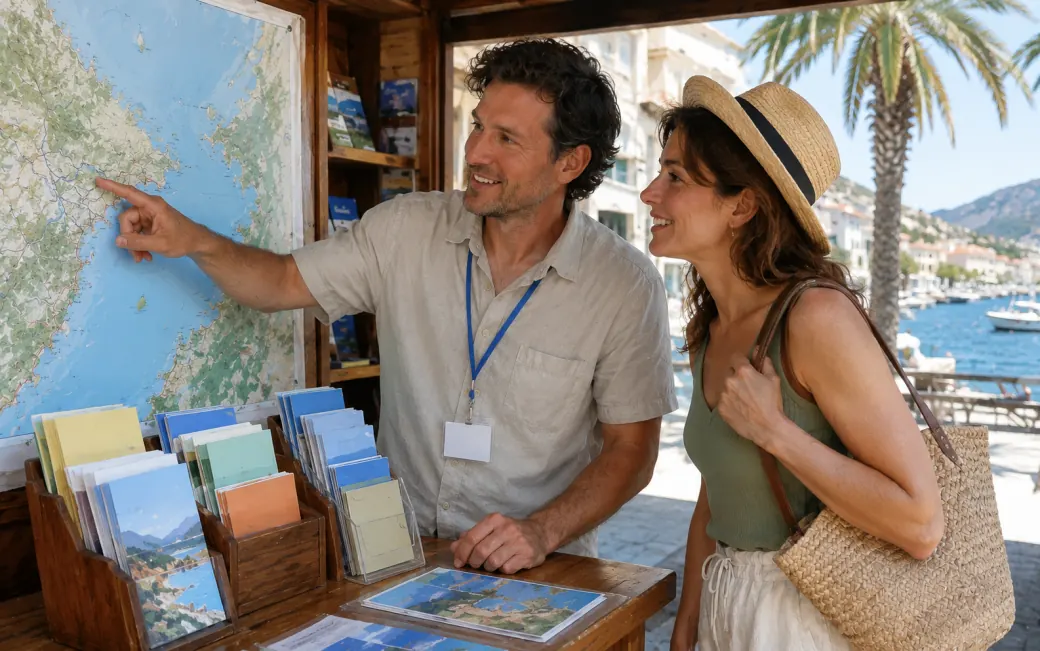
A tour operator's desk · you talk to the tour operator
Free plan: this lesson is free to play at every level, with 10 messages a day. No card needed. The Learning Plan makes messages unlimited — $1.99 a month or $14.99 a year, with a 7-day money-back guarantee.
What you have to do
Choose a tour, pick your date and group size, check the booking, and pay. You finish the lesson by getting there in conversation — not by answering questions about it. The tutor never stops to correct you; the feedback appears beside your own messages, and the completion screen collects it all.
How it opens
Hi there! Welcome — are you looking to book a tour today? What are you interested in seeing?
Spoken aloud by the tutor playing the tour operator.
The 5 steps that finish it
A step clears when you say the thing that clears it. The steps are identical at all four levels — only the example line fades, and at Natural there is none at all.
- 01
Say what you want
Say hello, and say what kind of tour you're interested in.
“Hi! I'd like to book a city tour, please.”
- 02
Give your date
Say what date or day you'd like to go.
“Saturday, please.”
- 03
Say your group size
Say how many people are going, or what time you'd prefer.
“There are two of us, in the morning.”
- 04
Check the booking
Check the booking is right, and ask how much it costs.
“Yes, that's everything. How much is it?”
- 05
Pay and confirm
Say how you'd like to pay, and confirm the booking.
“By card, please. Thanks!”
The words, at all four levels
The same room and the same steps, four vocabularies. These are the words the lesson listens for and scores you on — with what each one means and how it sounds when you are talking to the tour operator.
Starter
A1 – A2Simple, everyday words with a full hint on every step.
- tour
- a trip to see a place with a guide
- “I'd like to book a tour.”
- city
- a large town
- “I'd like a city tour, please.”
- day
- one full day
- “Which day is it on?”
- group
- a number of people together
- “There are two in our group.”
- morning
- the early part of the day
- “In the morning, please.”
- ticket
- a paper or code that lets you join
- “How much is one ticket?”
- price
- how much something costs
- “What's the price?”
- book
- to reserve something in advance
- “I'd like to book a tour.”
- card
- a bank card you pay with
- “By card, please.”
- thanks
- a short way to say thank you
- “Thanks so much!”
Conversational
A2 – B1Common words at a natural pace, with hints to lean on.
- guide
- a person who shows people around
- “Does the tour come with a guide?”
- sightseeing
- visiting famous or interesting places
- “I'd like a sightseeing tour.”
- afternoon
- the part of the day after midday
- “Saturday afternoon works well.”
- includes
- has as part of it
- “That price includes breakfast.”
- reserve
- to book something in advance
- “Could I reserve a spot?”
- discount
- a reduction in price
- “Is there a discount for groups?”
- pickup
- collecting someone from a location
- “Is there a hotel pickup?”
- confirm
- to say something is definitely settled
- “Could you confirm the time?”
- cash
- paper money and coins
- “I'll pay in cash.”
- welcome
- a friendly greeting to someone arriving
- “Thanks, and you're welcome to join us.”
Confident
B1 – B2Richer, more specific words, with only light hints.
- excursion
- a short organised trip
- “I'd like to book a guided excursion.”
- itinerary
- a planned route or schedule
- “Could you talk me through the itinerary?”
- admission
- the right to enter a place
- “Does that include admission fees?”
- availability
- whether something is free to book
- “Is there any availability this weekend?”
- deposit
- a partial payment to secure a booking
- “Do you need a deposit today?”
- guided
- led by a guide
- “I'd prefer a guided walk.”
- complimentary
- given free of charge
- “Is the water complimentary?”
- refundable
- able to be paid back if cancelled
- “Is the deposit refundable?”
- slot
- a specific time set aside for something
- “Is there an earlier slot available?”
- voucher
- a printed pass exchanged for a service
- “I'll need a voucher for that, right?”
Natural
B2 – C1Advanced, idiomatic words — no hints at all.
- bespoke
- made or planned to suit someone specifically
- “Do you offer anything more bespoke?”
- offbeat
- unusual, away from the typical route
- “I'd love something a bit offbeat.”
- curated
- carefully chosen and put together
- “It's a nicely curated little route.”
- seamless
- smooth, without any awkward gaps
- “The booking process was seamless.”
- immersive
- deeply engaging, feels like you're really there
- “We're after something immersive.”
- insider
- known only to people with special knowledge
- “Any insider spots worth adding?”
- unmissable
- so good it shouldn't be skipped
- “That stop is meant to be unmissable.”
- picturesque
- visually charming, like a picture
- “It winds through some picturesque streets.”
- hallmark
- a defining, typical feature
- “That's the hallmark of this route.”
- wanderlust
- a strong desire to travel
- “This trip is really feeding my wanderlust.”
More Travel & Transport lessons
- Buying a train ticket
- Airport check-in & security
- Lost luggage
- Hotel check-in
- Hostel check-in
- Asking for directions
- Tourist information
- Taxi / rideshare
- Hiring a car
- Ferry crossing
- Changing a booking