English speaking lesson · Travel & Transport
How to Take a Taxi in English: Phrases, Dialogues & Speaking Practice
Last updated:
To take a taxi in English, say where you're going as soon as you get in: "Hi, could you take me to the airport, please?" The driver may ask which way you'd like to go, tell you how long it'll take, and ask how you're paying at the end. Below you'll find a full driver–passenger dialogue at four levels (A1 to C1), the phrases worth copying, and a free lesson where you practice it with an AI driver.
The dialogues use American English ($). British differences are covered in the FAQ.
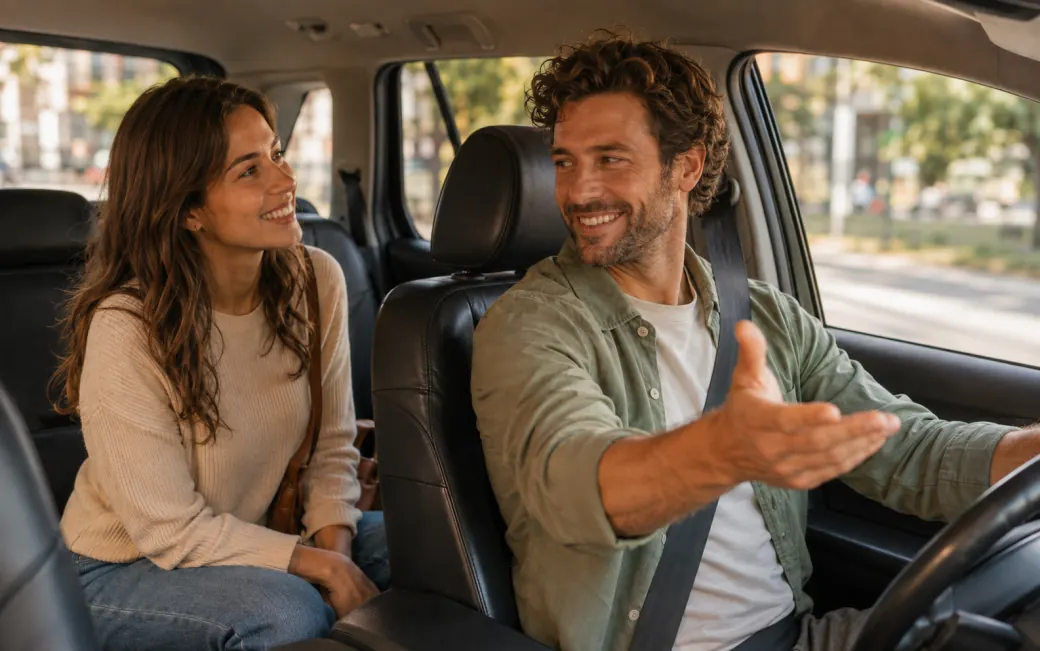
You've got into a taxi. The driver is friendly and ready to take you where you need to go. You practice it as a real conversation with a free AI English tutor, at whichever of the four levels fits you — the room and the steps stay the same, only the words get harder.
The back of a taxi · you talk to the driver
Free plan: this lesson is free to play at every level, with 10 messages a day, shared across Free Talk and all lessons, corrections on 3 messages per conversation, and standard support. No card needed. The Learning Plan adds unlimited messages and corrections, and priority support — from $1.99 a month or $14.99 a year up to $9.99 a month or $49.99 a year, depending on your region, with a 7-day money-back guarantee. New subscribers get a 7-day free trial of the Learning Plan.
Taxi dialogue in English: four levels
The same ride, four ways. Each dialogue follows the lesson's five steps and uses words from that level's word list.
Starter · A1–A2
- Driver:Afternoon! Hop in — where can I take you today?
- You:Hello! To the train station, please.
- Driver:Sure. The quick way or the cheap way?
- You:The quick way, please.
- Driver:OK. Do you need to stop anywhere?
- You:Yes. Can we stop at a store, please? Just for one minute.
- Driver:No problem. … OK, here's the station.
- You:Stop here, please. How much is it?
- Driver:It's $24.
- You:By card, please.
- Driver:Here you go. Have a good day!
- You:Thanks!
Conversational · A2–B1
- Driver:Afternoon! Hop in — where can I take you today?
- You:Hi! Could you take me to the airport, please?
- Driver:Sure thing. Which terminal?
- You:Terminal B. What's the quickest way — is there much traffic?
- Driver:The highway's busy, so I'll take the river road. About 30 minutes.
- You:Sounds good. Could we stop briefly at an ATM on the way?
- Driver:No problem — there's one just ahead.
- You:Thanks. You can drop me at the corner by the entrance. What's the fare?
- Driver:It's $42 on the meter.
- You:Can I pay contactless?
- Driver:Sure — just tap here.
- You:Great, thanks!
Confident · B1–B2
- Driver:Afternoon! Hop in — where can I take you today?
- You:Afternoon — Terminal 2 at the airport, please.
- Driver:Got it. Highway or local roads?
- You:Which route's best at this time of day? Roughly how long are we looking at?
- Driver:The highway — I'd estimate 35 minutes.
- You:Great. Would you mind a quick detour to an ATM first?
- Driver:Not at all — there's one on the way.
- You:Thanks. You can drop me at departures, by door 4. What's on the meter?
- Driver:$51.
- You:Here's $60 — keep the change. Could I get a receipt?
- Driver:Of course. Have a good flight!
- You:Thanks, I appreciate it.
Natural · B2–C1
- Driver:Afternoon! Hop in — where can I take you today?
- You:Hey! JFK, Terminal 4, please.
- Driver:You got it. Fair warning — the expressway's gridlock at the moment.
- You:Can you cut through the backstreets? I don't mind which way, as long as it's quicker.
- Driver:I'll take local roads. Ballpark, 45 minutes.
- You:Works for me. No stops — straight there, please.
- Driver:Straight there. Whereabouts at Terminal 4?
- You:Anywhere near the Delta doors is perfect.
- Driver:Here's a good spot. That's $68 on the meter.
- You:I'll tap — and add a tip. Thanks for the fast ride!
- Driver:Appreciate it. Safe travels!
More travel lessons: Try Airport check-in & security, Hiring a car or Asking for directions. Related guide: How to stop translating in your head when you speak English.
Useful English phrases for taking a taxi
Copy these and you can handle almost any taxi or rideshare. Each one has a copy button.
Where you're going
Could you take me to the airport, please?
To this address, please. — and show it on your phone.
How long will it take?
Roughly how much will it cost?
On the way
Which way is quicker?
Could we stop at an ATM on the way?
I'm in a bit of a hurry.
Arriving
You can drop me here.
Could you stop just past the light?
Right here is fine, thanks.
Paying
How much is it?
Can I pay by card?
Keep the change.
Could I get a receipt?
What the driver might say
Understanding the questions is half the job. These are the ones you'll hear most.
Where to? — where do you want to go?
Which terminal?
Highway or local roads?
Traffic's bad today.
Here we are. — you've arrived.
That's $24 on the meter.
Do you need a receipt?
What you have to do
Tell the driver your destination, sort the route, and settle the fare. You finish the lesson by getting there in conversation — not by answering questions about it. The tutor never stops to correct you; the feedback appears beside your own messages, and the completion screen collects it all.
How it opens
Afternoon! Hop in — where can I take you today?
Spoken aloud by the tutor playing the driver.
The 5 steps that finish it
A step clears when you say the thing that clears it. The steps are identical at all four levels — only the example line fades, and at Natural there is none at all.
- 01
Give your destination
Tell the driver where you want to go.
“Hello! To the train station, please.”
- 02
Talk about the route
Say which way you'd prefer to go, or ask which is quicker.
“The quick way, please.”
- 03
Ask for a stop
Ask to make a quick stop, or say you'd like to go straight there.
“Can we stop at a shop, please?”
- 04
Arrive
Say where to drop you, and ask how much it is.
“Stop here, please. How much is it?”
- 05
Pay the fare
Say how you'd like to pay, and finish politely.
“By card, please. Thanks!”
The words, at all four levels
The same room and the same steps, four vocabularies. These are the words the lesson listens for and scores you on — with what each one means and how it sounds when you are talking to the driver.
Starter
A1 – A2Simple, everyday words with a full hint on every step.
- station
- where trains stop
- “To the station, please.”
- please
- a polite word when you ask
- “The station, please.”
- left
- the opposite of right
- “Turn left here.”
- right
- the opposite of left
- “Turn right, please.”
- stop
- to pause the trip
- “Please stop here.”
- here
- in this place
- “Stop here, please.”
- quick
- fast
- “The quick way, please.”
- much
- used to ask the price
- “How much is it?”
- card
- a bank card you pay with
- “By card, please.”
- thanks
- a short thank you
- “Thanks a lot!”
Conversational
A2 – B1Common words at a natural pace, with hints to lean on.
- airport
- where planes take off
- “To the airport, please.”
- quickest
- the fastest
- “What's the quickest way?”
- motorway
- a fast main road
- “Take the motorway.”
- traffic
- cars slowing the road
- “Is there much traffic?”
- corner
- where two streets meet
- “Just at the corner.”
- briefly
- for a short time
- “Can we stop briefly?”
- drop
- to let you out — 'drop off'
- “Drop me at the corner.”
- fare
- the price of the ride
- “What's the fare?”
- contactless
- tapping a card to pay
- “Contactless, please.”
- cheers
- informal thanks
- “Cheers, mate!”
Confident
B1 – B2Richer, more specific words, with only light hints.
- terminal
- an airport building
- “Terminal two, please.”
- route
- the way you travel
- “Which route is best?”
- diversion
- a different way round
- “Is there a diversion?”
- estimate
- a rough guess of cost/time
- “Any estimate on time?”
- detour
- a short trip off the route
- “Just a quick detour.”
- roughly
- about, approximately
- “Roughly how long?”
- meter
- the device showing the fare
- “Is the meter on?”
- receipt
- the printed proof of payment
- “Could I get a receipt?”
- sorted
- arranged and settled
- “That's sorted, thanks.”
- appreciate
- to be grateful for
- “I'd appreciate that.”
Natural
B2 – C1Advanced, idiomatic words — no hints at all.
- terminal
- an airport building
- “The north terminal, please.”
- backstreets
- small quiet roads
- “Take the backstreets.”
- gridlock
- heavy stuck traffic
- “Is it gridlock ahead?”
- ballpark
- a rough figure
- “A ballpark on the fare?”
- nip
- to go quickly (informal)
- “Can we nip to a shop?”
- whereabouts
- roughly where
- “Whereabouts do you want?”
- meter
- the device showing the fare
- “What's on the meter?”
- spot
- a place to stop
- “This spot's fine.”
- cheers
- informal thanks
- “Cheers, appreciated.”
- sorted
- arranged and settled
- “Perfect, we're sorted.”
Taking a taxi in English: FAQ
What do you say when you get in a taxi?
Say hello and your destination: "Hi, could you take me to Central Station, please?" If the address is hard to say, show it on your phone and say "This address, please."
What's the difference between a taxi and a rideshare?
A taxi is a licensed cab that you hail on the street or find at a taxi stand, usually paid by the meter. A rideshare, like Uber or Lyft, is booked and usually paid in an app, so you see the price before you ride.
Do you tip taxi drivers?
In the US, 15–20% is usual, and many card machines suggest it. In the UK, tipping isn't required, but rounding up the fare is common.
How do you tell the driver where to stop?
Say "You can drop me here," "Right here is fine," or "Could you stop just past the light?" At an airport, say "Departures, please" and the terminal or door number.
What English level do I need to take a taxi?
A1 is enough. The Starter dialogue above uses only basic words like "station", "stop" and "how much". Higher levels add more natural phrases — "a quick detour", "the expressway's gridlock" — but the steps are the same.
How can I practice taking a taxi in English?
Read the dialogue for your level out loud, then practice it in the free lesson with an AI driver. In the lesson you speak or type your way through all five steps and get corrections beside each message, without being interrupted.
More Travel & Transport lessons
- Buying a train ticket
- Airport check-in & security
- Lost luggage
- Hotel check-in
- Hostel check-in
- Asking for directions
- Tourist information
- Hiring a car
- Booking a tour
- Ferry crossing
- Changing a booking