English speaking lesson · Travel & Transport
Hiring a car
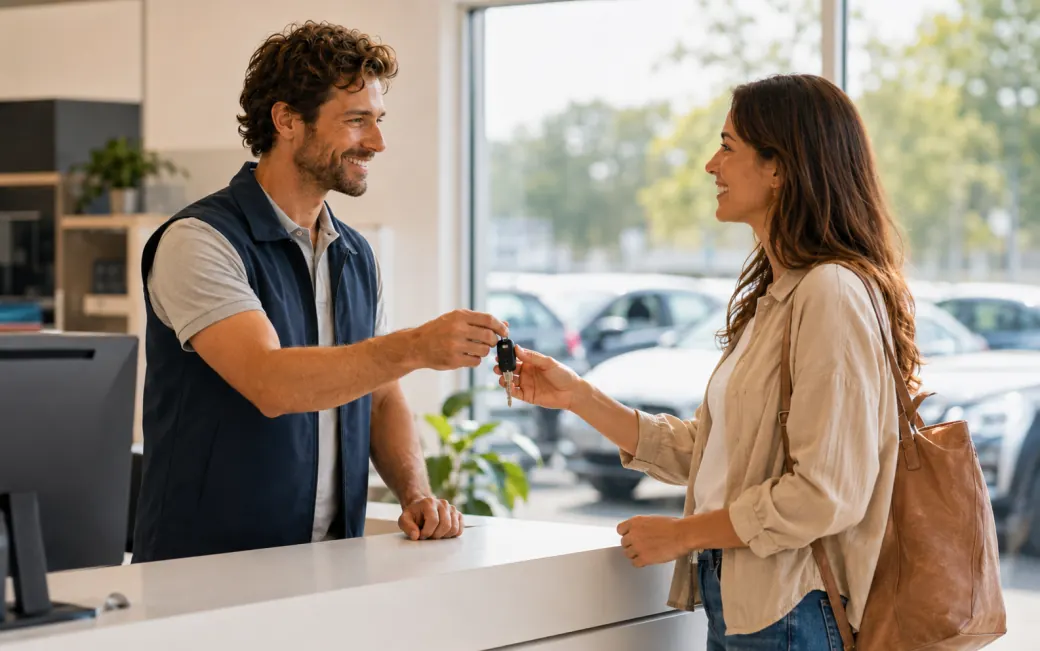
You're at a car hire desk, ready to pick up a rental car for your trip. You practice it as a real conversation, at whichever of the four levels fits you — the room and the steps stay the same, only the words get harder.
A car hire desk · you talk to the car hire desk assistant
Free plan: this lesson is free to play at every level, with 10 messages a day. No card needed. The Learning Plan makes messages unlimited — $1.99 a month or $14.99 a year, with a 7-day money-back guarantee.
What you have to do
Say what car you need, give your dates, add any extras, check the booking, and get the keys. You finish the lesson by getting there in conversation — not by answering questions about it. The tutor never stops to correct you; the feedback appears beside your own messages, and the completion screen collects it all.
How it opens
Hi there! Are you here to pick up a rental car?
Spoken aloud by the tutor playing the car hire desk assistant.
The 5 steps that finish it
A step clears when you say the thing that clears it. The steps are identical at all four levels — only the example line fades, and at Natural there is none at all.
- 01
Say what car you need
Say hello, and say what kind of car you'd like.
“Hi! A small car, please.”
- 02
Give your dates
Say how many days you'll need the car for.
“For three days, please.”
- 03
Add any extras
Ask for an extra you'd like, or say you don't need any.
“Do I need insurance too?”
- 04
Check the booking
Check the booking is right, and ask how much it costs.
“Yes, that's everything. How much is it?”
- 05
Get the keys
Take the keys, and ask a question if you have one.
“By card, please. Thanks for the keys!”
The words, at all four levels
The same room and the same steps, four vocabularies. These are the words the lesson listens for and scores you on — with what each one means and how it sounds when you are talking to the car hire desk assistant.
Starter
A1 – A2Simple, everyday words with a full hint on every step.
- car
- a vehicle you drive
- “A small car, please.”
- small
- not big
- “A small car, please.”
- days
- more than one day
- “For three days, please.”
- three
- the number 3
- “For three days.”
- insurance
- protection in case of damage
- “Do I need insurance?”
- map
- something that shows you the way
- “Do you have a map?”
- much
- used to ask the price — 'how much'
- “How much is it?”
- keys
- what you use to start a car
- “Here are your keys.”
- please
- a polite word when you ask
- “A small car, please.”
- card
- a bank card you pay with
- “By card, please.”
Conversational
A2 – B1Common words at a natural pace, with hints to lean on.
- automatic
- a car that changes gear by itself
- “An automatic, please.”
- compact
- a smaller, easy-to-park car
- “Something compact would be great.”
- duration
- how long you'll have something
- “The duration is five days.”
- coverage
- what an insurance plan protects
- “What's the coverage like?”
- satnav
- a device that gives directions
- “Could I add a satnav?”
- mileage
- the distance you're allowed to drive
- “Is the mileage unlimited?”
- everything
- all of it — 'is that everything?'
- “That's everything, thanks.”
- total
- the full amount to pay
- “What's the total?”
- cheers
- informal thanks
- “Cheers for that!”
- contactless
- tapping a card to pay without a PIN
- “Contactless, please.”
Confident
B1 – B2Richer, more specific words, with only light hints.
- estate
- a car with extra boot space
- “Have you got an estate available?”
- excess
- the amount you'd pay first on a claim
- “What's the excess on the insurance?”
- waiver
- cover that removes the excess
- “Is a waiver available?”
- unlimited
- with no set limit
- “Is the mileage unlimited?”
- additional
- extra, added on top
- “Any additional driver fee?”
- collection
- picking something up
- “Where's the collection point?”
- altogether
- in total — 'how much altogether'
- “How much altogether?”
- receipt
- the printed proof of payment
- “Could I get a receipt?”
- sorted
- arranged and settled
- “That's sorted, thanks.”
- appreciate
- to be grateful for
- “I'd appreciate that.”
Natural
B2 – C1Advanced, idiomatic words — no hints at all.
- upgrade
- a better car than what was booked
- “Any chance of an upgrade?”
- topped
- filled, as in 'topped up' with fuel
- “Does it come topped up?”
- prang
- a small collision (informal)
- “What happens if there's a prang?”
- poke
- to briefly try something (informal)
- “Mind if I poke around the settings?”
- drop-off
- the place you return the car
- “Is there a drop-off nearby?”
- swing
- to go somewhere briefly (informal)
- “Can I swing by early?”
- damage
- the cost — 'what's the damage?' (informal)
- “What's the damage overall?”
- tap
- to pay by touching your card
- “I'll just tap.”
- cheers
- informal thanks
- “Cheers, appreciated.”
- sorted
- dealt with and settled
- “Perfect, we're sorted.”
More Travel & Transport lessons
- Buying a train ticket
- Airport check-in & security
- Lost luggage
- Hotel check-in
- Hostel check-in
- Asking for directions
- Tourist information
- Taxi / rideshare
- Booking a tour
- Ferry crossing
- Changing a booking