English speaking lesson · Travel & Transport
Buying a train ticket
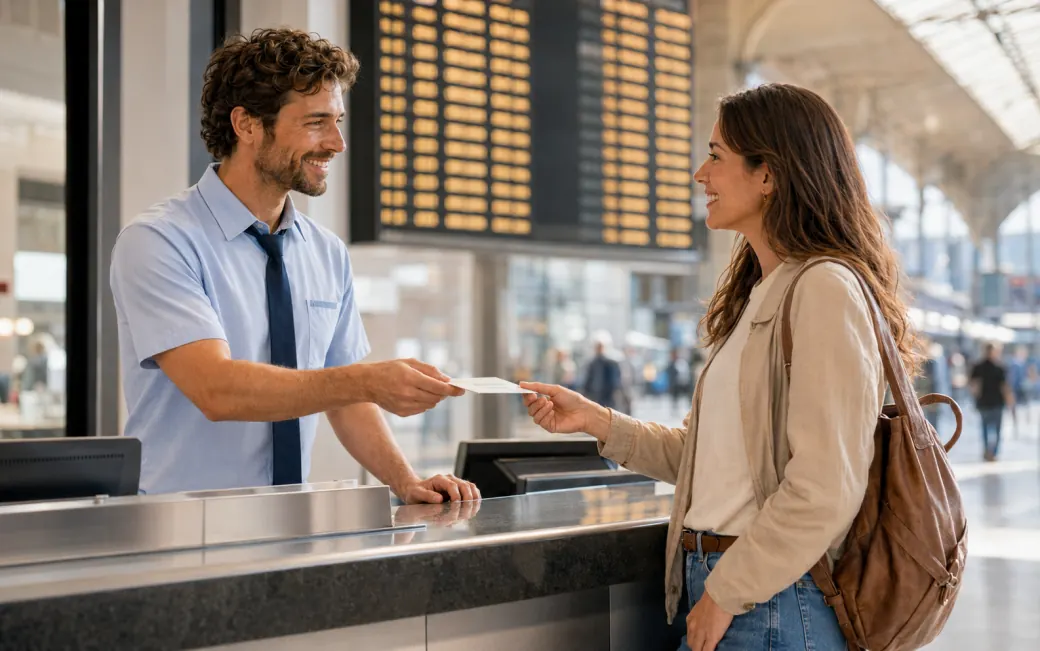
You're at a train station ticket counter, ready to buy a ticket for your journey. You practice it as a real conversation, at whichever of the four levels fits you — the room and the steps stay the same, only the words get harder.
A train station counter · you talk to the ticket clerk
Free plan: this lesson is free to play at every level, with 10 messages a day. No card needed. The Learning Plan makes messages unlimited — $1.99 a month or $14.99 a year, with a 7-day money-back guarantee.
What you have to do
Say where you're going, choose your ticket type and time, check the ticket, and pay. You finish the lesson by getting there in conversation — not by answering questions about it. The tutor never stops to correct you; the feedback appears beside your own messages, and the completion screen collects it all.
How it opens
Morning! Where are you travelling to today?
Spoken aloud by the tutor playing the ticket clerk.
The 5 steps that finish it
A step clears when you say the thing that clears it. The steps are identical at all four levels — only the example line fades, and at Natural there is none at all.
- 01
Say where you're going
Say which station you'd like to travel to.
“Morning! One ticket to Leeds, please.”
- 02
Choose your ticket
Say whether you'd like a single or a return.
“A return, please.”
- 03
Say when you'd like to travel
Say what time you'd like to travel.
“The next train, please.”
- 04
Check the ticket
Check the ticket is right, and ask how much it costs.
“Yes, that's right. How much is it?”
- 05
Pay and finish
Say how you'd like to pay, and finish politely.
“By card, please!”
The words, at all four levels
The same room and the same steps, four vocabularies. These are the words the lesson listens for and scores you on — with what each one means and how it sounds when you are talking to the ticket clerk.
Starter
A1 – A2Simple, everyday words with a full hint on every step.
- ticket
- a paper or code that lets you travel
- “One ticket, please.”
- train
- a vehicle that runs on rails
- “The next train, please.”
- single
- a ticket for one way only
- “A single, please.”
- return
- a ticket for there and back
- “A return, please.”
- time
- the hour something happens
- “What time is the train?”
- next
- the one right after this
- “The next train, please.”
- platform
- where you wait for the train
- “Which platform is it?”
- much
- used to ask the price — 'how much'
- “How much is it?”
- please
- a polite word when you ask
- “One ticket, please.”
- card
- a bank card you pay with
- “By card, please.”
Conversational
A2 – B1Common words at a natural pace, with hints to lean on.
- journey
- a trip from one place to another
- “How long is the journey?”
- off-peak
- outside the busy, more expensive times
- “Is there an off-peak fare?”
- departs
- leaves at a certain time
- “When it departs, please tell me.”
- changing
- swapping to a different train partway
- “Am I changing trains?”
- direct
- with no changes needed
- “Is there a direct one?”
- platform
- where you wait for the train
- “Which platform is that?”
- everything
- all of it — 'is that everything?'
- “That's everything, thanks.”
- total
- the full amount to pay
- “What's the total?”
- cheers
- informal thanks
- “Cheers for that!”
- contactless
- tapping a card to pay without a PIN
- “Contactless, please.”
Confident
B1 – B2Richer, more specific words, with only light hints.
- fare
- the price of a journey
- “What's the cheapest fare?”
- advance
- booked ahead of time
- “Is an advance fare cheaper?”
- flexible
- not tied to one specific train
- “I'd like it flexible, if possible.”
- reserved
- a seat kept for you specifically
- “Could I get a reserved seat?”
- connection
- a second train you catch after the first
- “Is there a tight connection?”
- carriage
- one section of the train
- “Which carriage is quiet?”
- altogether
- in total — 'how much altogether'
- “How much altogether?”
- receipt
- the printed proof of payment
- “Could I get a receipt?”
- sorted
- arranged and settled
- “That's sorted, thanks.”
- appreciate
- to be grateful for
- “I'd appreciate that.”
Natural
B2 – C1Advanced, idiomatic words — no hints at all.
- peak
- the busiest, most expensive time to travel
- “Is that a peak fare?”
- railcard
- a card that gives a discount on fares
- “Does a railcard help here?”
- stopover
- a short stop partway through a journey
- “Is there a stopover?”
- hop
- to switch trains quickly (informal)
- “I'd rather not hop trains.”
- tight
- not much time — 'a tight connection'
- “That connection sounds tight.”
- leg
- one part of a longer journey
- “The first leg's the tricky one.”
- damage
- the cost — 'what's the damage?' (informal)
- “What's the damage?”
- tap
- to pay by touching your card
- “I'll just tap.”
- cheers
- informal thanks
- “Cheers, appreciated.”
- sorted
- dealt with and settled
- “Perfect, we're sorted.”
More Travel & Transport lessons
- Airport check-in & security
- Lost luggage
- Hotel check-in
- Hostel check-in
- Asking for directions
- Tourist information
- Taxi / rideshare
- Hiring a car
- Booking a tour
- Ferry crossing
- Changing a booking